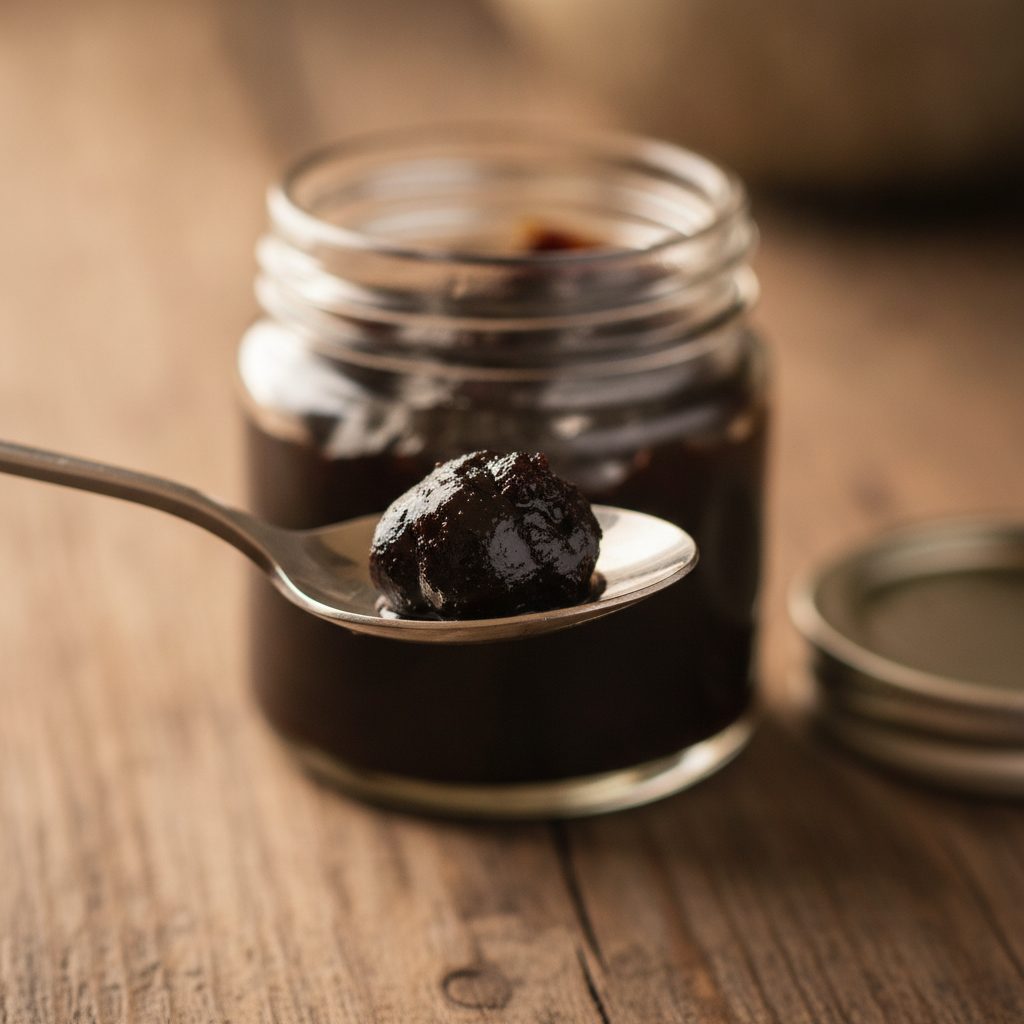
There is no recommended daily allowance for shilajit, no FDA-approved dose, and no official monograph that tells you how much to take. Every number you will see online traces back to one of three places: a handful of small human trials, the label on a standardised extract, or traditional use. That is worth saying plainly before any figure, because it changes how much confidence a dose deserves. Here is what the trials actually used, why a milligram of extract is not the same as a milligram of resin, and whether the popular advice to cycle shilajit holds up.
Educational content, not medical advice. Talk to a qualified clinician before taking shilajit, especially if you are pregnant or breastfeeding, take medication, or have a health condition.
The honest starting point: no official dose exists
Shilajit is a dietary supplement, not a drug, so it has not been through the process that produces an official dose. The main published safety review concluded that shilajit appears well tolerated in the studies done so far, but it did not set a recommended human dose and specifically called for more trials using standardised products. That is the state of the evidence. Anyone quoting a single authoritative daily number is filling a gap that the science has not filled.
The main safety review found shilajit well documented for safety in animal and human studies but did not specify a recommended human dose and called for more controlled studies using standardised products. [Stohs 2014] Strong evidence
What the trials actually used
Published human trials have dosed shilajit across a wide range, roughly 200 to 2,000 mg per day, but the most common and most cited regimen sits around 500 mg per day, usually split into two doses. Two studies anchor the practical picture. In the testosterone trial, healthy men aged 45 to 55 took 250 mg of purified shilajit twice daily, a total of 500 mg per day, for 90 days. In the sperm-count trial, men took 100 mg of processed shilajit twice daily, a total of 200 mg per day, for 90 days.
A purified shilajit trial dosed 250 mg twice daily, 500 mg per day total, for 90 days in healthy middle-aged men and reported raised testosterone markers. [Pandit 2016] Moderate evidence
A processed shilajit trial dosed 100 mg twice daily, 200 mg per day total, for 90 days and reported improved sperm count and semen parameters. [Biswas 2010] Moderate evidence
The most useful number comes from a study that compared doses directly. Over eight weeks, an exercise trial pitted 250 mg per day against 500 mg per day, and only the 500 mg group retained muscular strength after fatigue and showed the connective-tissue change the researchers were looking for. That is a rare head-to-head, and it is the main reason 500 mg per day of a standardised product is a reasonable target for people who want to mirror the better outcomes rather than the minimum.
In a direct dose comparison over eight weeks, only the 500 mg per day group retained muscular strength after fatigue, while the 250 mg per day group did not. [Keller 2019] Moderate evidence
Standardised extract is not the same as raw resin
This is the distinction almost every dosing guide skips, and it is the one that matters most. The trials used purified, standardised extract, so their milligram figures describe standardised extract with a defined active content. A 500 mg standardised capsule and a 500 mg blob of raw resin are not interchangeable, because the amount of fulvic acid, the marker constituent, varies enormously between products. Independent lab testing has driven this home: across a set of shilajit products, fulvic acid per serving ranged from under 7 mg to over 2,000 mg, a difference of roughly 32,000 percent.
Independent testing of shilajit products found fulvic acid per serving ranged from 6.9 mg to 2,206 mg, a variation of nearly 32,000 percent, and resins tended to contain far less fulvic acid than capsule and tablet extracts. [ConsumerLab 2024] Strong evidence
The practical rule that falls out of this is to dose to the active content on the certificate of analysis, not to gross weight. If you take resin and eyeball a rice-grain to pea-size amount, you are estimating both the weight and the actives, and two products of the same visual size can deliver very different doses. A standardised capsule removes one layer of that guesswork, which is a large part of why it is the simplest way to actually take a known amount.
A dose by form
| Form | Typical daily amount | Dose accuracy | Note |
|---|---|---|---|
| Standardised capsule or tablet | 250 to 500 mg, often split in two | High | Closest to the trial doses and the easiest to take a known amount |
| Resin | Rice-grain to pea-size, roughly 300 to 500 mg | Low, eyeballed | Highest raw fulvic acid per gram, but visual dosing is imprecise |
| Powder | Around 250 to 500 mg | Medium to high if weighed | Only precise with a milligram scale |
| Gummy | 1 to 2 gummies, extract varies by brand | Medium, label-dependent | Check the actual extract milligrams and the added sugar |
A conservative way to start
- Start around 200 to 250 mg per day for the first week or two to check tolerance, since mild digestive upset was reported in a small share of trial participants.
- If it sits well, titrate up toward 500 mg per day of a standardised product, the amount with the most consistent positive human data.
- Splitting into two doses matches how the trials dosed and may be gentler on the stomach.
- Taking it with food is fine; the sperm-count trial dosed with meals and still produced its result.
- Doses below 250 mg per day are under-studied, and above roughly 1,000 mg per day there is little long-term safety data, so there is no good reason to chase big numbers.
Mild gastrointestinal upset was reported in a small minority of participants in the purified shilajit trial, which supports starting low and increasing gradually to check tolerance. [Pandit 2016] Moderate evidence
Do you need to cycle shilajit?
A popular piece of advice is to cycle shilajit, typically six to eight weeks on followed by a one to two week break, on the theory that this prevents tolerance or receptor desensitisation. It sounds scientific, but there is no clinical evidence that shilajit causes tolerance, and the phrase receptor desensitisation is being borrowed from pharmacology without support. The strongest counterpoint is the trials themselves. The studies that produced positive results dosed continuously for 90 days with no washout period, so the evidence base was built on uninterrupted use, not cycling.
The positive shilajit trials dosed continuously for 90 days with no washout period, and no clinical evidence shows shilajit causes tolerance requiring a cycling break. [Pandit 2016] Moderate evidence
The fairest way to describe cycling is as a cautious optional habit, not a requirement and not an evidence-based protocol. If a periodic break makes you feel more comfortable about long-term daily use, there is no evidence it hurts. But do not believe that skipping it will blunt the effects, because nothing in the research supports that, and long-term daily data on humans is still thin either way. The honest summary is that cycling is a preference dressed up as a rule.
What the brands claim vs what the evidence shows
Brand pages diverge from the evidence in two predictable ways. On dose, many quote a broad band such as 250 to 1,000 mg without distinguishing standardised extract from raw resin, which leaves buyers unable to tell whether a number is meaningful for the product in front of them. On cycling, several brands present a fixed on-off protocol as established best practice, complete with the tolerance rationale, even though the trials ran continuously and no tolerance has been shown. Some brands do the opposite and correctly note that cycling is not necessary, which is closer to the evidence.
Some vendors present a fixed six-to-eight-week on-off cycling protocol as established best practice to prevent tolerance, a claim not supported by clinical evidence. [Kashmiril cycling] Insufficient evidence
The reconciliation is straightforward. Where a brand quotes 250 to 500 mg of a standardised, lab-tested extract split across the day, it is close to the research. Where it quotes a big round number by gross weight, or sells cycling as a physiological necessity, treat that as marketing. Match your dose to the certificate of analysis, take it consistently, and let the size of the number matter less than the quality of what is behind it.
For a fuller walkthrough of dose numbers, see the dosage guide. To compare how accurately each format lets you dose, read resin vs powder vs capsules. And to make sure the product behind your dose is worth taking, the buying guide covers what to check.
Educational content, not medical advice. Talk to a qualified clinician before taking shilajit, especially if you are pregnant or breastfeeding, take medication, or have a health condition.
References
- Pandit S, et al. Clinical evaluation of purified shilajit on testosterone levels in healthy volunteers. Andrologia. 2016;48(5):570-5. PMID 26395129
- Biswas TK, et al. Clinical evaluation of spermatogenic activity of processed shilajit in oligospermia. Andrologia. 2010;42(1):48-56. PMID 20078516
- Keller JL, et al. The effects of shilajit supplementation on fatigue-induced decreases in muscular strength and serum hydroxyproline. J Int Soc Sports Nutr. 2019;16(1):3. PMID 30728074
- Stohs SJ. Safety and efficacy of shilajit (mumie, moomiyo). Phytother Res. 2014;28(4):475-9. PMID 23733436
- ConsumerLab.com. Shilajit supplements found to contain high amounts of fulvic acid. 2024. consumerlab.com
- Examine.com. Shilajit supplement monograph. examine.com
Leave a Reply