The questions people actually ask about shilajit, answered honestly against the primary literature. Where the research is solid we say so; where it is a single small study or only animal work, we say that too. Every health answer here is drawn from the studies cited across our science section.
Educational content, not medical advice. Shilajit is not a treatment for any condition. Speak to a qualified clinician before taking it, particularly if you are pregnant or breastfeeding, take medication, or have a health condition.
What shilajit is
What is shilajit?
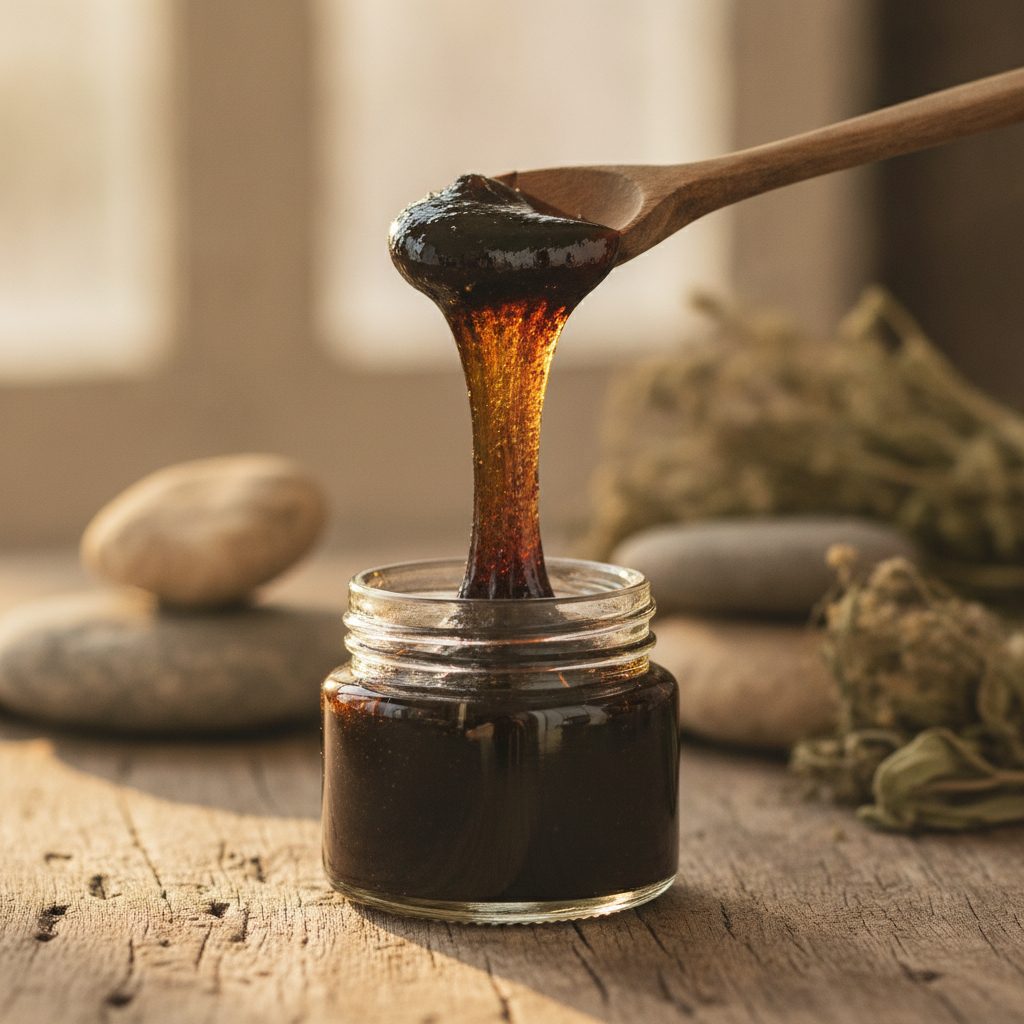
Shilajit is a sticky, tar-like material that seeps from cracks in high mountain rock, mainly in the Himalaya, Altai, and Caucasus ranges. Chemically it is a humic substance: the end-product of centuries of plant and microbial decomposition, concentrated in rock. Its two most studied components are fulvic acid and dibenzo-alpha-pyrones (DBPs).
What is shilajit made of?
Mostly humic substances (roughly 60 to 80 percent), plus fulvic acid, dibenzo-alpha-pyrones, and a minority fraction of minerals. The dominant measured minerals in one native-sample analysis were potassium, calcium, magnesium, and sodium.
Does shilajit really contain 84 minerals?
Almost certainly not as a guaranteed figure. When a native Himalayan sample was analysed with modern methods, labs detected roughly 16 elements, not 84. The “84 minerals” line is a marketing convention, not a measured count. Shilajit carries a variable spread of trace elements, and the amount is nutritionally small next to a normal diet.
What is fulvic acid?
Fulvic acid is a small, water-soluble humic molecule that acts as a carrier and antioxidant. It is one of shilajit’s active fractions. Its antioxidant, anti-inflammatory, and mitochondrial effects are interesting but mostly shown in test-tube and animal studies, not human trials.
Where does shilajit come from?
High mountain ranges: the Himalaya (including Gilgit-Baltistan), the Altai, the Caucasus, and similar regions across Russia, Kyrgyzstan, Nepal, India, and Iran. “Himalayan” is largely a marketing label; a matching, accredited lab certificate matters far more than the named region.
Is shilajit the same as mumijo or moomiyo?
Yes. Mumijo, moomiyo, and mumie are regional names for the same class of mountain-rock exudate used in Ayurvedic and Central Asian folk medicine.
Benefits and effects
Does shilajit increase testosterone?
There is one supporting study, and it is small. A 90-day randomised trial in men aged 45 to 55 found that purified shilajit (250 mg twice daily) raised total and free testosterone versus placebo (Pandit 2016). It is a single, manufacturer-linked study with no published effect sizes and no independent replication, so “may help, unproven” is the honest read. It says nothing about younger men or clinically low testosterone.
Does shilajit boost energy?
The best human evidence is a placebo-controlled trial where 500 mg per day for 8 weeks helped active men resist strength loss under fatigue (Keller 2019). That is a recovery and fatigue-resistance signal, not a stimulant effect. The popular “40% more ATP or CoQ10” claims trace to animal and marketing material, not human trials.
Can shilajit help with fertility?
One uncontrolled study in subfertile men found improved sperm count and quality after 90 days (Biswas 2010). Because it had no placebo group, the result cannot be firmly attributed to shilajit. It is promising but preliminary, and not a substitute for fertility care.
Is shilajit good for women?
The most interesting human data is a trial in postmenopausal women suggesting a benefit for bone-mineral density. Most other “for women” claims (energy, skin, hair) rely on the same thin, general evidence base as for men. There is no reason it works differently by sex, but the specific female research is limited.
Does shilajit help skin or hair?
Evidence is weak. The skin claim is often traced to a study that actually tested a topical fulvic-acid cream for eczema, not oral shilajit. There are no solid human trials showing that taking shilajit improves hair growth or skin. Treat these as marketing, not established benefits.
Can shilajit treat or prevent Alzheimer’s?
No. There is a laboratory finding that fulvic acid can interfere with tau-protein aggregation, which is why researchers find it interesting. That is a test-tube result. No human clinical evidence shows shilajit prevents or treats dementia.
How long before shilajit works?
The human trials ran for 8 to 12 weeks. If you are trying it, judge it over that window rather than a few days, and ideally track something objective (for testosterone, bloodwork). Many people who report quick effects are describing subjective energy or mood, which is prone to placebo.
Safety
Is shilajit safe?
Purified, third-party-tested shilajit appears well tolerated at studied doses. The real safety issue is raw or unpurified resin, which can concentrate heavy metals. The single most important safety step is buying a product with a recent third-party heavy-metal test.
What are the side effects of shilajit?
The most commonly reported effects are mild digestive upset, such as loose stools or nausea, especially at higher doses or on an empty stomach. Taking it with food tends to reduce this. Allergic reactions and, rarely, dizziness or blood-pressure changes have been reported.
Does shilajit contain heavy metals?
It can. Because the raw material absorbs whatever is in its host rock, unpurified shilajit may carry lead, arsenic, mercury, and thallium. A 2025 analysis found some finished supplements contained more thallium than the raw source (Kamgar 2025). A “purified” label is not a guarantee; insist on a recent lab certificate.
Who should not take shilajit?
Avoid it, or speak to a doctor first, if you are pregnant or breastfeeding, have hemochromatosis or another iron-overload condition (shilajit adds iron), take blood thinners or lithium, or have a chronic illness. Children should not take it. When in doubt, ask a clinician.
Can you take shilajit during pregnancy?
No. There is no safety data supporting use in pregnancy, the contamination risk is a particular concern, and at least one adverse-event case has been reported in a pregnant woman. Avoid it while pregnant or breastfeeding.
Does shilajit interact with medications?
Possibly. Because it contains iron and may affect blood pressure, caution is sensible with iron supplements, blood-pressure medication, and lithium. Most interaction concerns are theoretical rather than documented, which is exactly why you should clear it with a pharmacist or doctor if you take prescription drugs.
Is it regulated by the FDA?
Not as a drug. Shilajit is sold as a dietary supplement, so it is not pre-market tested by the FDA for purity or effectiveness. Quality is entirely down to the brand, which is why third-party lab testing is the key buying criterion.
How to take it
How much shilajit should I take?
There is no official recommended dose. The human trials used 250 to 500 mg per day of purified or standardized material. With resin, that is roughly a rice-grain to pea-sized amount. Start low, take it with food, and do not assume more is better.
When is the best time to take shilajit?
There is no proven “best” time. The trials generally dosed it with meals, split across the day. Morning with food is a reasonable default. Some people avoid it late in the day in case the perceived energy effect disturbs sleep.
How do you dissolve shilajit resin?
Dissolve a small amount in warm (not boiling) water, milk, or tea, and stir until it disperses. Genuine resin dissolves cleanly; grit or residue that will not dissolve is a warning sign about the product.
Resin, powder, capsules, or gummies: which is best?
Resin is usually the most potent and best value per dose. Powder is the most commonly adulterated. Capsules offer convenience and consistent dosing. Gummies tend to contain small doses plus added sugar. Whatever the form, the deciding factor is a published lab certificate.
Do you need to cycle shilajit?
There is no evidence you must cycle it. The trials dosed it continuously for up to 90 days without a described “receptor desensitisation” effect. Cycling advice is largely a supplement-community convention, not a research finding.
Buying and authenticity
How can I tell if shilajit is real?
The reliable answer is a recent third-party certificate of analysis showing heavy metals within limits and the fulvic-acid content. Home tests are only rough screens: genuine resin dissolves in warm water, softens when warm and hardens when cold, and tastes bitter, not sweet. None of those alone proves purity.
Does the dissolve test or flame test prove purity?
No. The dissolve test only rules out insoluble fillers like sand. The flame test only catches petroleum-based fakes and gives false results with some materials. They are useful screens, not proof. A lab certificate is the only real proof.
How much should shilajit cost?
Genuine, lab-tested resin runs roughly $1.30 to $2.70 per gram at 2026 prices. Anything advertised as “pure Himalayan” for a few dollars a jar is a red flag: proper sourcing and testing cost money.
What is a certificate of analysis (COA)?
A COA is a third-party lab report for a specific batch. A good one shows heavy-metal results (lead, arsenic, mercury, cadmium, ideally thallium) within accepted limits, plus active-compound content such as fulvic acid. If a brand will not show a recent, batch-matched COA, treat that as your answer.
Where should I buy shilajit?
Buy from brands that publish current third-party lab certificates and are transparent about sourcing and batch dating. Avoid unbranded cheap resin and heavily-marketed gummies with no testing. Our buying guide walks through how to verify a product step by step.
Still have a question?
If your question is not here, start with the science section for the evidence, the buying guide for choosing a product, or how to take shilajit for dosing. You can also contact us and we will point you to the relevant research.