
Shilajit is sold as resin, powder, capsules, gummies and honey sticks, and the marketing for each insists it is the superior form. The honest answer is that there is no single best form; there is a trade-off between potency, dose accuracy, taste and how likely you are to actually take it every day. This comparison lays out where each form wins and loses, so you can pick the one that fits how you will really use it.
Educational content, not medical advice. Talk to a qualified clinician before taking shilajit, especially if you are pregnant or breastfeeding, take medication, or have a health condition.
The core trade-off: potency versus precision
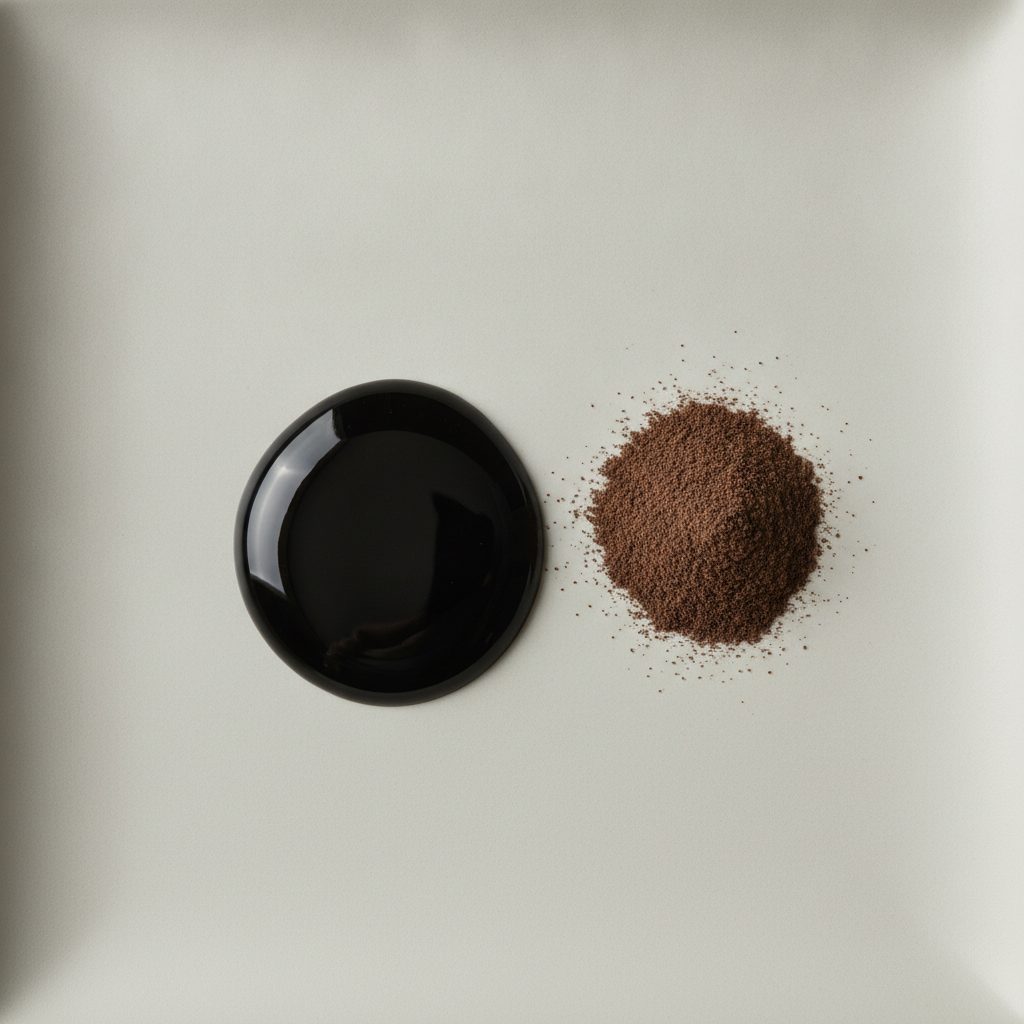
Nearly every form debate comes down to one tension. Resin offers the highest raw fulvic-acid concentration per gram, but its taste is bitter and tar-like, it is messy, and it is dosed by eye. Capsules and powder give precise, consistent, tasteless dosing but often start from a more processed material. Gummies win on taste and adherence but tend to carry added sugar and vaguer active content. None of that makes one form objectively best; it makes each better for a different priority.
Resin offers the highest raw fulvic-acid concentration per gram but has a bitter tar-like taste, is messy, and uses imprecise pea-size dosing. [HerbToBody comparison] Preliminary evidence
Form by form
Capsules and powder
For dose accuracy, capsules and powder lead. A capsule delivers a fixed, tasteless amount, and this is the format used in several of the human trials, including the sperm-count study that used a processed shilajit capsule. That is a genuine point in their favour that resin sellers tend to downplay: if your goal is to mirror what the studies did, a standardised capsule is the closest match. Powder is equally precise, but only if you weigh it on a milligram scale; without one, it becomes the same guesswork as resin.
Capsules give precise, consistent dosing, and the processed-shilajit capsule was the format used in the human sperm-count trial. [Biswas 2010] Moderate evidence
Resin
Resin is the connoisseur’s choice and the concentrated one, but it asks the most of the user. It has to be dissolved in warm water or milk, it tastes strongly bitter, and the pea-size dose is eyeballed rather than measured. The dosing imprecision is its real weakness, and it is the number-one complaint people raise about resin.
Gummies
Gummies win on taste, consistency and portability, which is why many people who bounce off resin stick with them. The catch that comparison pages tend to gloss over is added sugar. A typical gummy carries around 2 to 4 grams of sugar, often as cane sugar or tapioca syrup, and taken daily that becomes a small but real cumulative sugar load. Low or zero-sugar versions using stevia or monk fruit exist and are worth seeking out. The active content per gummy also varies by brand, and heat processing used to make some gummies and extracts may lower fulvic acid, so check both the sugar and the actual extract milligrams on the label.
Gummies often contain added sugar of roughly 2 to 4 grams per serving and can carry lower actives per serving, with heat processing potentially lowering fulvic acid. [Spiruswastha comparison] Preliminary evidence
Honey sticks and blends
Honey sticks and blends are palatable, but they dilute the active ingredient and add sugar, and the amount of actual shilajit per stick is often left unstated. That transparency problem makes them the hardest form to dose meaningfully. They are convenience over clarity.
Honey sticks and blends add sugar and dilute the active, and the actual shilajit dose per stick is frequently unstated. [HerbToBody comparison] Insufficient evidence
Side-by-side comparison
| Form | Dose accuracy | Additives | Taste and mess | Best for |
|---|---|---|---|---|
| Capsule or tablet | High, exact | Minimal | None | Mirroring the trial doses; first-timers |
| Resin | Low, eyeballed | None if pure | Bitter, sticky, messy | Highest raw fulvic acid per gram |
| Powder | Medium to high if weighed | Minimal | Bitter | Precision if you own a mg scale |
| Gummy | Medium, label-dependent | Added sugar, 2 to 4 g typical | Pleasant | Adherence and taste |
| Honey stick or blend | Low, opaque | Sugar or honey | Pleasant | Convenience over transparency |
The standardized versus raw point that decides it
Whichever form you choose, one rule cuts through the marketing. The trial milligram figures refer to standardised extract with a defined fulvic-acid content, not to gross weight of raw material, and fulvic-acid content varies enormously between products. A 500 mg resin scoop and a 500 mg standardised capsule can deliver very different amounts of active compounds. Buy to the fulvic-acid figure on the certificate of analysis, and treat a recent third-party heavy-metal test as the non-negotiable baseline, whatever the form.
Trial milligram figures refer to standardized extract, and fulvic-acid content varies enormously across products, so form matters less than matching dose to the fulvic-acid spec on the certificate of analysis. [Carrasco-Gallardo 2012] Strong evidence
So which should you pick?
If you want to stay closest to the evidence and dose without guesswork, a standardised capsule is the straightforward pick. If you value the most concentrated raw material and do not mind the taste and the eyeballing, resin makes sense. If you know you will only keep a habit that tastes good, a low-sugar gummy that states its extract content may serve you better than a jar of resin you skip. As one recurring community line puts it, consistency beats peak potency: the form you actually take every day beats the stronger one you abandon.
To go deeper, see how to dose each form in the dosage guide, how to judge purity in the buying guide, and what the studies genuinely support in the benefits overview.
Educational content, not medical advice. Talk to a qualified clinician before taking shilajit, especially if you are pregnant or breastfeeding, take medication, or have a health condition.
References
- Biswas TK, et al. Clinical evaluation of spermatogenic activity of processed shilajit in oligospermia. Andrologia. 2010;42(1):48-56. PMID 20078516
- Carrasco-Gallardo C, et al. Shilajit: a natural phytocomplex with potential procognitive activity. Int J Alzheimers Dis. 2012;2012:674142. PMC3296184
Leave a Reply