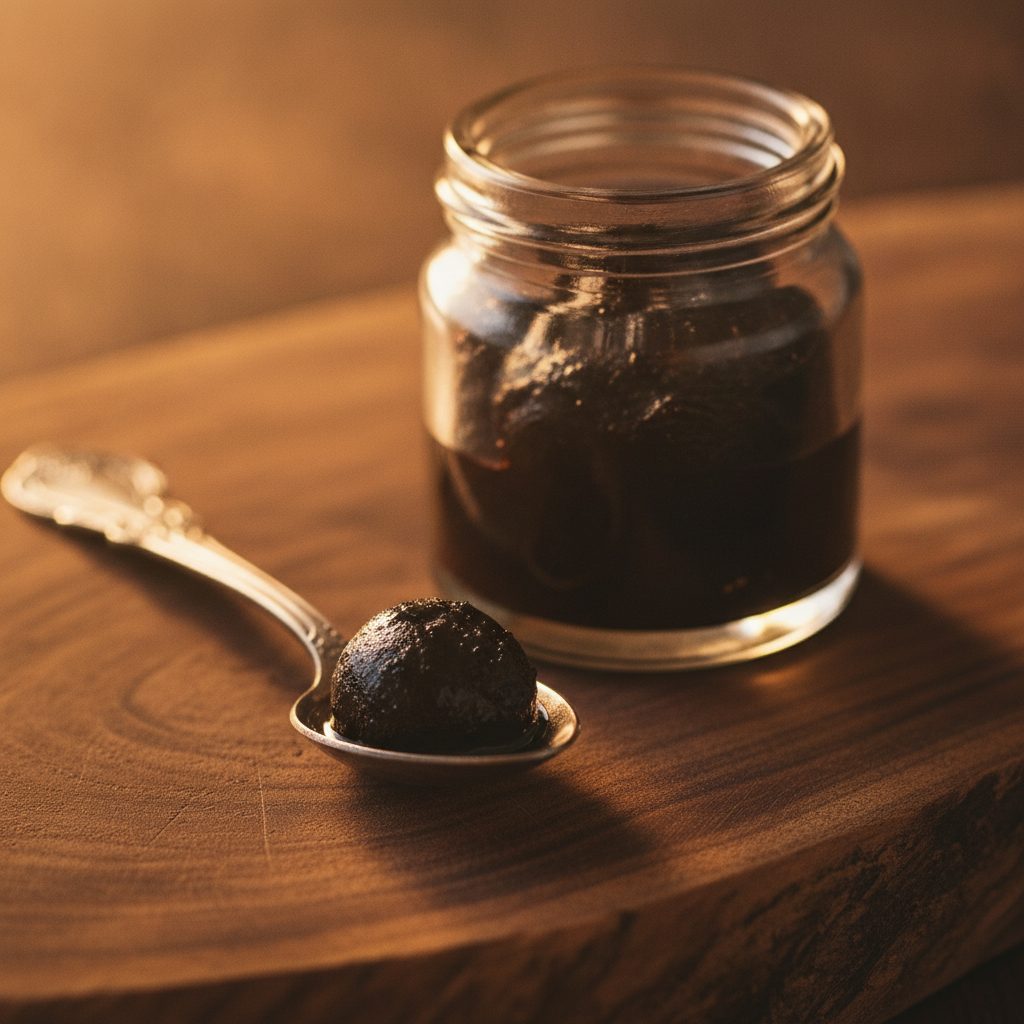
There is no official recommended dose for shilajit. No RDA, no FDA-approved dose, no monograph from the NIH Office of Dietary Supplements. What exists instead is a handful of small human trials, a few manufacturer-standardised extract labels, and centuries of traditional Ayurvedic practice. Any honest dosage guide has to start there, so this page works from the numbers the published studies actually used, and flags where those numbers stop applying.
Educational content, not medical advice. Talk to a qualified clinician before taking shilajit, especially if you are pregnant or breastfeeding, take medication, or have a health condition.
What the trials actually used
Across the published human studies, shilajit doses have ranged from roughly 200 mg to 2,000 mg per day, with the most common regimen sitting around 500 mg daily, usually split into two doses. That range is a summary of trial doses, not a recommendation, but it is the best anchor available.
Across published human trials, shilajit dosing has ranged from about 200 to 2,000 mg per day, with the most common regimen around 500 mg per day split into two doses. [Examine 2024] Moderate evidence
The individual trials are more informative than the range. The most cited dosing reference gave healthy men aged 45 to 55 a purified extract at 250 mg twice a day, 500 mg total, for 90 days, and reported higher total testosterone, free testosterone and DHEAS. That is a single small study in a specific group, so it is a reasonable reference point rather than proof of a universal dose.
Purified shilajit at 250 mg twice daily, 500 mg total per day for 90 days, raised total testosterone, free testosterone and DHEAS in healthy men aged 45 to 55. [Pandit 2016] Moderate evidence
A separate trial in men with low sperm counts used a lower dose, 100 mg of processed shilajit twice a day, 200 mg total, for 90 days, and reported improved sperm count and semen quality. So the studies do not converge on one figure. The clinical population and the endpoint being measured both shift the dose that was tested.
Processed shilajit at 100 mg twice daily, 200 mg total per day for 90 days, improved total sperm count and semen parameters in men with oligospermia. [Biswas 2010] Moderate evidence
The one head-to-head dose comparison came from an eight-week exercise study. It pitted 250 mg per day against 500 mg per day, and only the 500 mg group retained muscular strength after fatigue and showed increased muscle collagen expression. For physical-performance endpoints, that points to 500 mg as the more effective research dose.
In an 8-week exercise study, 500 mg per day outperformed 250 mg per day, with only the higher-dose group retaining muscular strength after fatigue. [Keller 2019] Moderate evidence
Why standardized mg and raw resin mg are not the same thing
This is the single most important, and most ignored, point about shilajit dosing. Every trial above used a purified, standardised extract with a defined fulvic-acid content, such as PrimaVie. So when a study says 250 mg or 500 mg, it means 500 mg of standardised extract, not 500 mg of raw resin scraped into a spoon.
The fulvic-acid content of commercial shilajit products has been reported to vary enormously per serving, so a standardized-extract milligram figure is not equivalent to the same weight of raw resin. [Carrasco-Gallardo 2012] Strong evidence
Because fulvic-acid content differs so widely between products, a 500 mg resin blob and a 500 mg standardised capsule can deliver very different amounts of the compounds that matter. The practical rule: match your dose to the fulvic-acid figure on the certificate of analysis, not to the gross weight on the jar. If a product does not state a fulvic-acid spec and does not carry a third-party heavy-metal test, the milligram number on the label tells you very little.
A practical dosing table
| Form | Typical dose used or marketed | Dose accuracy | Note |
|---|---|---|---|
| Standardized capsule or tablet | 250 to 500 mg/day, often split into two | High | Closest to the clinical trial doses; simplest for first-timers |
| Resin | Rice-grain to pea-size, roughly 300 to 500 mg/day | Low, eyeballed | Highest raw fulvic acid per gram, but visual dosing is imprecise |
| Powder | Around 250 to 500 mg/day | Medium to high if weighed | Precise only with a milligram scale |
| Gummy | 1 to 2 gummies, extract varies by brand | Medium, label-dependent | Check actual extract mg and added sugar |
A conservative starting approach
A cautious, evidence-anchored ramp is to start at around 200 to 250 mg per day for the first one to two weeks to check tolerance, then titrate up to about 500 mg per day if it agrees with you. Mild digestive upset was reported in fewer than 5 percent of trial subjects, and starting low tends to reduce it. Doses below 250 mg per day are under-studied, and doses above 1,000 mg per day lack long-term safety data. This is a synthesis of the trial doses and vendor guidance, not an official protocol.
Myths worth clearing up
Two dosing myths circulate widely. The first is that shilajit must be cycled, typically six to eight weeks on and one to two weeks off, to prevent tolerance. There is no clinical evidence of tolerance or receptor desensitisation to shilajit, and the trials that reported benefits dosed continuously for 90 days with no break. Cycling is a cautious optional habit at most, not a requirement. The second is that a bigger dose is always better. The trials do not support that; the useful signal clustered around 500 mg per day of standardised extract, and higher doses simply have less safety data behind them.
For the deeper picture, see how these doses were tested in our science overview, how to judge a product’s real potency in the buying guide, and the common questions answered in the FAQ.
Educational content, not medical advice. Talk to a qualified clinician before taking shilajit, especially if you are pregnant or breastfeeding, take medication, or have a health condition.
References
- Pandit S, et al. Clinical evaluation of purified shilajit on testosterone levels in healthy volunteers. Andrologia. 2016;48(5):570-5. PMID 26395129
- Biswas TK, et al. Clinical evaluation of spermatogenic activity of processed shilajit in oligospermia. Andrologia. 2010;42(1):48-56. PMID 20078516
- Keller JL, et al. The effects of shilajit supplementation on fatigue-induced decreases in muscular strength. J Int Soc Sports Nutr. 2019;16(1):3. PMID 30728074
- Carrasco-Gallardo C, et al. Shilajit: a natural phytocomplex with potential procognitive activity. Int J Alzheimers Dis. 2012;2012:674142. PMC3296184
- Examine.com. Shilajit monograph (secondary aggregator of trial doses). 2024. examine.com/supplements/shilajit
Leave a Reply