Does shilajit actually work, or is it another expensive jar of hope? The honest answer is that it depends entirely on what you expect it to do. There is a small amount of real human evidence pointing in a few directions, a much larger pile of animal and test-tube work, and a marketing machine that treats all of it as if it were settled. This page separates the three so you can judge for yourself whether shilajit is legit for the specific thing you are considering it for.
Educational content, not medical advice. Talk to a qualified clinician before taking shilajit, especially if you are pregnant or breastfeeding, take medication, or have a health condition.
What “work” even means here
Shilajit is not one claim, it is dozens. Sellers attach it to energy, testosterone, fertility, cognition, ageing, immunity, recovery, and more. Each of those needs its own evidence, and the quality varies wildly from one to the next. So the useful question is never “does shilajit work” in the abstract. It is “does shilajit do this particular thing, and how good is the proof.” Grouping every claim under one yes or no is exactly how marketing gets away with borrowing credibility from a single decent study and spreading it across a whole label.
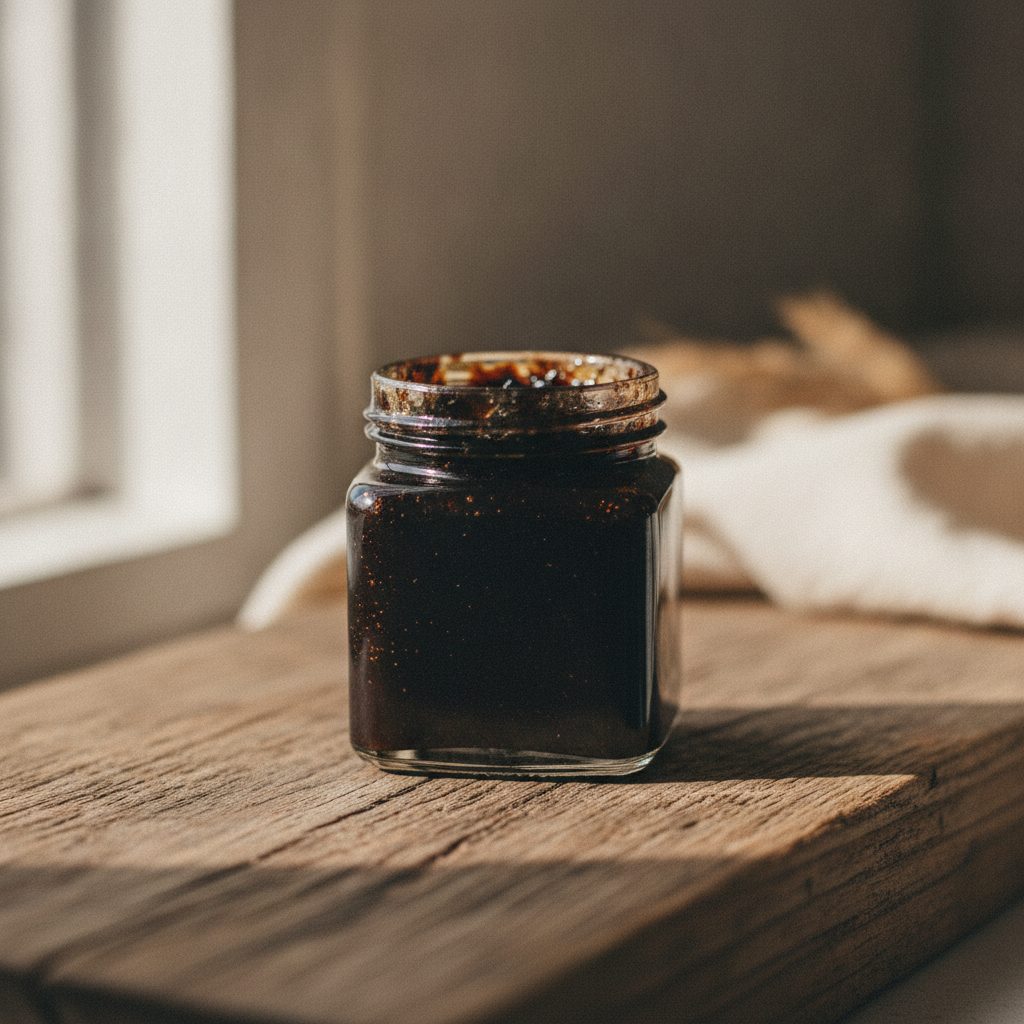
It also helps to know what shilajit is. It is a tar-like material that seeps from mountain rock, formed over long periods as plant matter breaks down and becomes trapped. Its two most consistently identified active fractions are fulvic acid and a group of compounds called dibenzo-alpha-pyrones. The chemistry is real and reasonably well described. The health claims are a separate matter, and they are where the gap between evidence and marketing is widest.
Shilajit is a humic material whose most consistently identified active components are dibenzo-alpha-pyrones, DBP-chromoproteins and fulvic acid. [Stohs 2014, Phytother Res] Strong evidence
Where the human evidence is actually decent
Two areas have genuine human trials behind them, and both deserve to be called preliminary rather than proven. The first is testosterone. A randomised, double-blind, placebo-controlled trial in healthy men aged 45 to 55 found that purified shilajit taken twice a day for 90 days significantly raised total testosterone, free testosterone and DHEAS compared with placebo. That study design is the strongest in the entire shilajit literature, which is why you see it quoted everywhere.
In healthy men aged 45 to 55, purified shilajit 250 mg twice daily for 90 days significantly raised total testosterone, free testosterone and DHEAS versus placebo in a randomised, double-blind, placebo-controlled trial. [Pandit 2016, Andrologia] Preliminary evidence
The second is exercise fatigue. An 8-week trial of a standardised shilajit extract in active adults reported that the higher dose group held onto muscle strength better after exhausting exercise, alongside changes in a marker of collagen breakdown. It is a small study, and it was run on one specific standardised material, but it is a real placebo-comparison human trial rather than a rodent experiment.
An 8-week randomised controlled trial of standardised shilajit in active adults reported better retention of muscular strength after fatiguing exercise in the higher-dose group, with good tolerability. [Keller 2019, J Int Soc Sports Nutr] Preliminary evidence
Notice the pattern. Both of the better claims come from a single small trial each, and both were conducted on purified, standardised extracts rather than random resin. That is not nothing. Most supplements do not have even this much. But one positive trial is a starting point, not a conclusion, and neither result has been independently replicated by a lab with no commercial stake in the outcome.
Where the evidence is thin or absent
For most of the other headline claims, the human evidence simply is not there yet. The antioxidant and anti-inflammatory story rests largely on fulvic acid in test tubes and animals, and the main review of fulvic acid concedes the supporting literature is minimal, with no large human trials and no established safe dosing across age groups. The same review notes fulvic acid can actually increase oxidative stress in some conditions, so even the antioxidant framing is not uniform.
Evidence for fulvic acid's antioxidant, anti-inflammatory and mitochondrial effects is largely in-vitro and animal, the supporting human literature is minimal, and fulvic acid can be pro-oxidant in some settings. [Winkler and Ghosh 2018, J Diabetes Res] Preliminary evidence
The cognition and Alzheimer’s angle is even earlier. It comes from a laboratory finding that fulvic acid can interfere with the self-aggregation of tau protein, plus hypothesis papers. That is a molecular observation, not evidence that shilajit prevents or treats dementia in a living person. And the widely shared eczema study that supplement pages sometimes cite as proof was topical, carbohydrate-derived fulvic acid applied to skin, which says nothing about swallowing shilajit.
The frequently cited eczema improvement came from a small trial of topical carbohydrate-derived fulvic acid applied to skin, not from oral shilajit, so it does not support taking shilajit by mouth for anything. [Gandy 2011, Clin Cosmet Investig Dermatol] Moderate evidence
Government sources land in the same place. The US Department of Defense supplement-safety service states plainly that there is little reliable evidence to support the popular claims that shilajit boosts energy, vitality, stamina, endurance and mental performance, and that most research has been done in animals.
The US Department of Defense Operation Supplement Safety states there is little reliable evidence to support claims that shilajit enhances energy, vitality, stamina, endurance and mental performance, with most research conducted in animals. [OPSS, US DoD] Insufficient evidence
The industry-funding problem
There is a quieter issue that changes how you should read the good studies. The small human trials cluster around one standardised commercial ingredient, and the research tends to be tied to the supplier of that ingredient. That does not automatically make the results wrong, but it is a well-known source of optimistic bias in supplement science, and it is a reason independent replication matters so much. A widely cited safety and efficacy review reached the same conclusion, calling for additional well-controlled human studies using standardised products before firm claims are made.
A safety and efficacy review of shilajit concluded that relatively few well-controlled human studies exist and called for more standardised, well-controlled human research before firm efficacy conclusions. [Stohs 2014, Phytother Res] Moderate evidence
What the brands claim vs what the evidence shows
Brand pages tend to present the whole benefit list as established. Some describe shilajit as a source of energy, vitality and mineral support, promote fulvic acid as an antioxidant, and lean on the 84 or 85 minerals figure as evidence of nutritional value. The testosterone trial is often cited without the caveats that it was a single small study on middle-aged men using a purified extract. The distance between the two columns is stark.
- Brands say it raises testosterone. Evidence shows one small, unreplicated, likely supplier-linked trial in men aged 45 to 55, which is a preliminary signal, not proof for younger men or men with clinically low levels.
- Brands say it boosts energy and stamina. Evidence shows one small exercise-fatigue trial plus government guidance that reliable evidence for energy and stamina claims is lacking.
- Brands say its fulvic acid is a powerful antioxidant. Evidence shows mostly test-tube and animal data, with the main review calling the human literature minimal and noting pro-oxidant effects in some settings.
- Brands say its 84 minerals support broad health. Evidence shows the mineral count is a marketing figure and the amounts are small next to a normal diet.
To be fair to a few sellers, better ones are honest about heavy-metal risk and about using purified, tested material. But almost none of them foreground how small and how few the human trials are.
What real users report
Community discussion in supplement and nootropics forums is a useful reality check, as long as it is read as anecdote rather than evidence. The recurring themes are consistent. Many users describe a mild lift in energy or mood over a few weeks, some describe nothing at all, and a sizeable sceptical contingent openly raises the placebo question, noting that the honest testosterone evidence is thin and tied to industry. People who report benefit often cannot separate it from the fact that they also started sleeping better, training, or paying more attention to their health at the same time.
Two other patterns stand out. First, users worry a lot about whether their resin is fake or contaminated, which tells you the product-quality problem is real and widely felt. Second, the most experienced users tend to give the same practical advice that the evidence supports: buy purified, third-party lab-tested material, start with a low dose, take it with food to reduce stomach upset, and judge it on how you actually feel rather than on the label. That is a sensible way to run a personal test, and it is more honest than any benefit list.
So does it actually work?
Here is the fair summary. For testosterone in middle-aged men and for exercise fatigue, there is a single small human trial each suggesting a real effect, which is genuinely more than most supplements can show, but is a long way from proof. For energy, cognition, immunity, ageing and the rest, the human evidence ranges from thin to absent, and the strongest sources say so directly. Whether that adds up to “worth trying” depends on your budget, your expectations, and your tolerance for uncertainty.
If you do try it, treat it as an experiment on yourself rather than a proven treatment. Use a purified product with a recent certificate of analysis, give it 8 to 12 weeks, and where possible measure something objective such as bloodwork so you are judging by data instead of hope. For the underlying studies see our science overview, for what the substance actually is read what is shilajit, and before you buy, the buying guide covers how to avoid contaminated or mislabelled products.
Educational content, not medical advice. Talk to a qualified clinician before taking shilajit, especially if you are pregnant or breastfeeding, take medication, or have a health condition.
References
- Stohs SJ. Safety and efficacy of shilajit. Phytother Res. 2014;28(4):475-9. PMID 23733436
- Pandit S, et al. Clinical evaluation of purified shilajit on testosterone levels in healthy volunteers. Andrologia. 2016;48(5):570-5. PMID 26395129
- Keller JL, et al. The effects of shilajit supplementation on fatigue-induced decreases in muscular strength and serum hydroxyproline. J Int Soc Sports Nutr. 2019;16:3. PMID 30728074
- Winkler J, Ghosh S. Therapeutic potential of fulvic acid in chronic inflammatory diseases and diabetes. J Diabetes Res. 2018;2018:5391014. PMID 30276216
- Gandy JJ, Snyman JR, van Rensburg CEJ. Randomized study of topical carbohydrate-derived fulvic acid in eczema. Clin Cosmet Investig Dermatol. 2011;4:145-8. PMID 21931500
- Operation Supplement Safety (US DoD). Shilajit as a dietary supplement ingredient. opss.org
Leave a Reply