
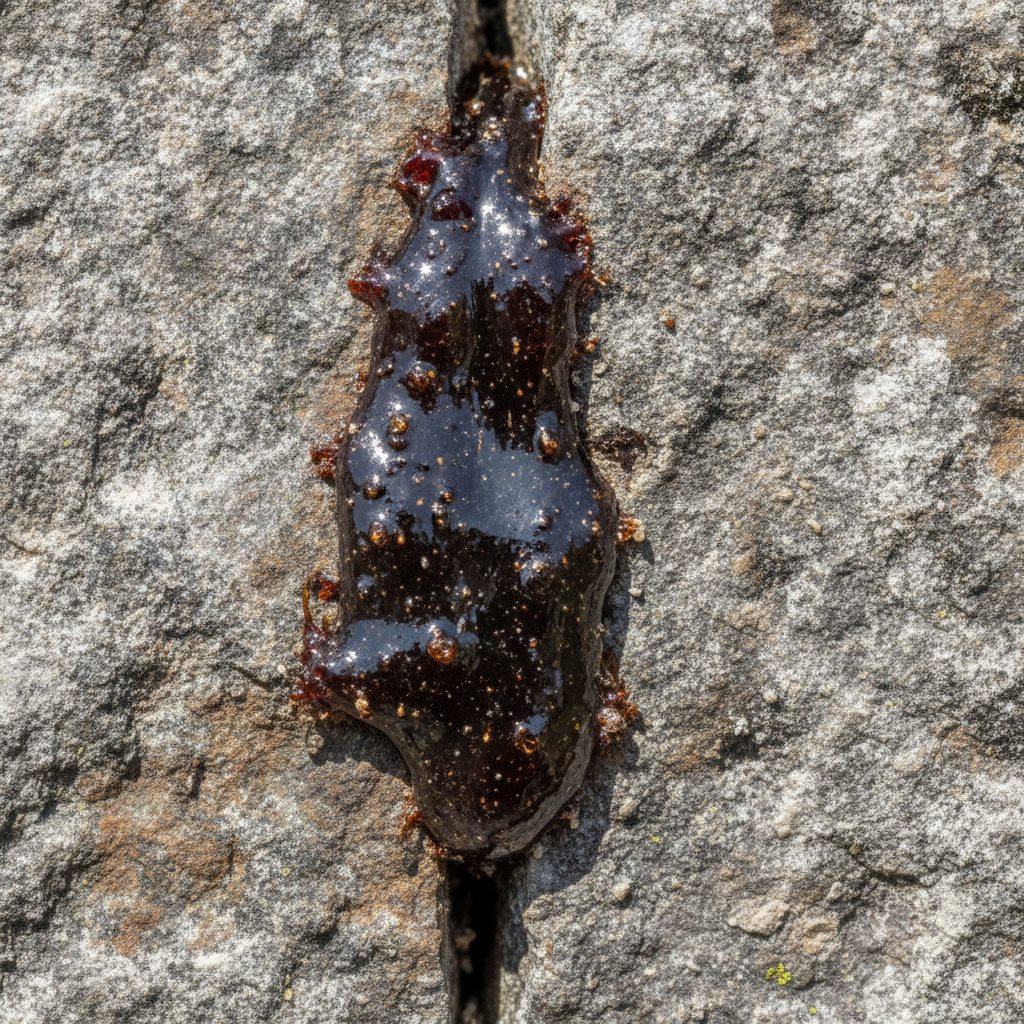
Shilajit is sold as a mystical super-mineral, but it is easier to understand as something ordinary and specific: a sticky, tar-like organic material that seeps out of cracks in high mountain rock. This guide sets out what it actually is, how it forms, what the lab genuinely finds inside it, and where the popular marketing runs ahead of the chemistry.
Educational content, not medical advice. Talk to a qualified clinician before taking shilajit, especially if you are pregnant or breastfeeding, take medication, or have a health condition.
What shilajit actually is
Shilajit (also called mumijo, moomiyo, or mumie) is a blackish-brown exudate that oozes from rock crevices in high mountain ranges. It is not a mineral you dig out and it is not a plant you harvest. The most accurate description is that it is a humic material: the compressed end-product of centuries of plant and microbial decomposition, trapped in rock and slowly pushed out by heat. Think concentrated organic matter with some trapped minerals, rather than a magical stone.
Shilajit is a humic material formed over centuries by the gradual microbial decomposition of plant matter compressed in mountain rock, a process known as humification. [Carrasco-Gallardo 2012] Moderate evidence
The traditional names all point at the same class of material used in Ayurvedic and Central Asian folk medicine. Whether a jar is labelled shilajit, mumijo, or moomiyo, it is describing the same broad thing.
The traditional names mumie, mumijo and moomiyo refer to the same class of material used in Ayurvedic and Central Asian folk medicine. [Stohs 2014] Moderate evidence
How it forms and where it comes from
The formation story is decomposition on a geological timescale. Plant and microbial matter breaks down (a process called humification), gets compressed inside rock over centuries, and the resulting humic material is slowly forced out of crevices. The exact parent plants are an open question. Various species have been proposed, but that part is informed hypothesis rather than settled fact, and honest sources say so.
Shilajit is chiefly a humic material, with humic substances such as fulvic and humic acids making up roughly 60 to 80 percent of the total mass. [Carrasco-Gallardo 2012] Moderate evidence
Geographically, shilajit is most associated with the Himalaya, but it also turns up in the Altai, the Caucasus, and other high ranges. Analytical studies have sampled crude material from Iran, India, Nepal, Russia, and Kyrgyzstan, which gives a sense of the spread. One practical consequence: because it forms from whatever is local, its makeup varies from region to region and even from crevice to crevice.
Shilajit is found in the Himalaya and also across the Altai, Caucasus and other high ranges, with crude samples documented from Iran, India, Nepal, Russia and Kyrgyzstan. [Kamgar 2025] Moderate evidence
What is actually inside it
Two organic fractions do the work researchers care about. Fulvic acid is a small, water-soluble humic molecule that acts as a carrier and antioxidant. Dibenzo-alpha-pyrones (DBPs) and their chromoprotein complexes are the compounds most consistently singled out as shilajit’s characteristic actives. This carrier-plus-DBP model traces back to the foundational chemistry work of Shibnath Ghosal, which most of the modern literature still builds on.
The compounds most consistently identified as shilajit's characteristic actives are dibenzo-alpha-pyrones, DBP-chromoproteins, and fulvic acid. [Stohs 2014] Strong evidence
The rest is a variable inorganic mineral load, which is a real but minority fraction of the mass. When a native Himalayan sample was run through modern elemental analysis, the dominant elements were potassium, calcium, magnesium, and sodium, with a scattering of trace elements alongside them.
In a native Himalayan sample the inorganic mineral fraction was a minority of the mass, dominated by potassium, calcium, magnesium and sodium with only trace amounts of other elements. [Basavaraja 2025, ACS Omega] Moderate evidence
The “84 minerals” claim, checked against the lab
Almost every brand repeats that shilajit contains 84 (or 85) minerals. That number is a marketing convention, not a measured count. When a native sample was put through combined elemental methods, the labs detected on the order of sixteen elements, not eighty-four. The honest framing is that shilajit carries a variable spread of trace elements, and the mineral amount is small relative to a normal diet.
Direct chemical analysis of native Himalayan shilajit detected roughly 16 elements across combined methods, contradicting the popular 84-minerals figure. [Basavaraja 2025, ACS Omega] Moderate evidence
Raw resin versus standardised product
Because composition varies so much, a jar of unstandardised raw resin tells you very little about what you are actually taking. Purification is meant to remove contaminants and set defined minimum levels of the actives. The leading standardised ingredient, PrimaVie from Natreon, is specified to defined levels of total bioactives, fulvic acids, DBPs, and DBP-chromoproteins. That specification is what makes dose meaningful. It is worth saying plainly, though, that a purity claim on a label is not the same as an independent test, a point we cover in the buying guide.
Purification is meant to remove contaminants and standardise the actives, and the leading standardised ingredient PrimaVie is specified to defined minimum levels of total bioactives, fulvic acids, dibenzo-alpha-pyrones and DBP-chromoproteins. [Pandit 2016, Andrologia] Moderate evidence
What the research does not support
The chemistry of shilajit is reasonably well characterised. The popular claims around it are weaker. The 84-minerals figure is unsourced. The idea that shilajit detoxes heavy metals from your body has no credible evidence, and the documented issue runs the other way: raw material can add heavy metals to your intake. Human health trials are few, small, and often tied to a single ingredient supplier, so firm efficacy conclusions are not warranted from what exists today.
There is no credible evidence that shilajit detoxes heavy metals from the body; raw shilajit can instead add heavy metals, including thallium, to a person's intake. [Kamgar 2025] Moderate evidence
The overall evidence base is small and heavily tied to one supplier, so reviewers call for additional well-controlled human and animal studies using standardised products before firm efficacy conclusions. [Stohs 2014] Insufficient evidence
None of this means shilajit is useless. It means the accurate summary is measured: an interesting humic material with real chemistry, a modest human evidence base, and a genuine safety caveat around raw resin. If you want to go deeper, our science hub lays out every graded claim, the fulvic acid explainer covers the single most-discussed compound, and the how to take guide covers dosing once you have chosen a tested product.
Educational content, not medical advice. Talk to a qualified clinician before taking shilajit, especially if you are pregnant or breastfeeding, take medication, or have a health condition.
References
- Carrasco-Gallardo C, et al. Shilajit: a natural phytocomplex with potential procognitive activity. Int J Alzheimers Dis. 2012;2012:674142. PMC3296184
- Stohs SJ. Safety and efficacy of shilajit. Phytother Res. 2014;28(4):475-9. PMID 23733436
- Kamgar E, et al. Quantifying thallium in shilajit and its supplements. BMC Chemistry. 2025. PMID 39827344
- Basavaraja D, et al. Chemical analysis of native Himalayan shilajit. ACS Omega. 2025;10(47):57097-106. PMID 41404054
- Pandit S, et al. Clinical evaluation of purified shilajit on testosterone levels in healthy volunteers. Andrologia. 2016;48(5):570-5. PMID 26395129
Leave a Reply