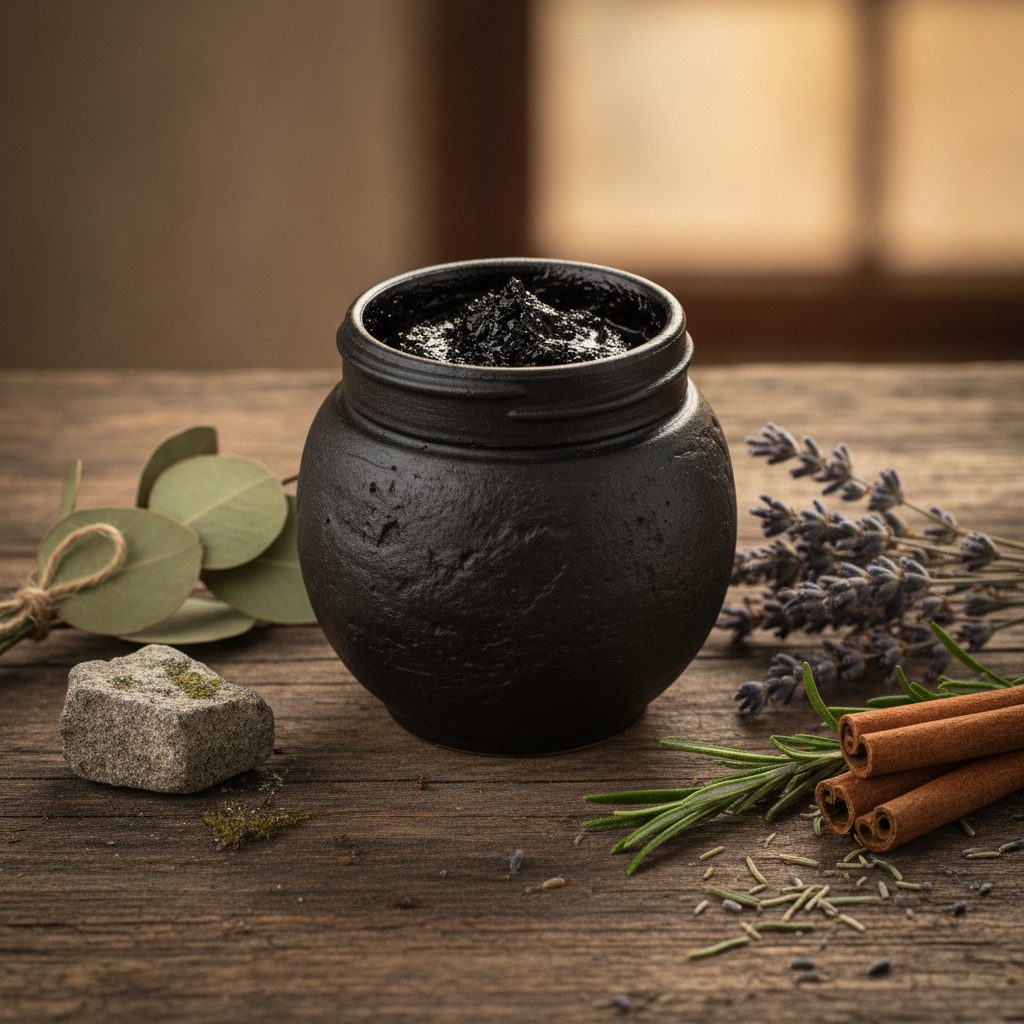
Ask what shilajit is good for and you will get a list of a dozen confident promises: energy, testosterone, immunity, brain health, anti-aging, better skin, thicker hair. Almost none of those rest on a human trial. A small handful do. This page ranks the benefits by the evidence that actually exists, tells you which model each study used, and is honest about how much of the popular list is animal work, test-tube work, or tradition dressed up as science.
Educational content, not medical advice. Talk to a qualified clinician before taking shilajit, especially if you are pregnant or breastfeeding, take medication, or have a health condition.
The short answer, graded
Across the whole shilajit literature, only three human endpoints are genuinely trial-backed: muscle fatigue-resistance in exercising men, a small testosterone rise in middle-aged men, and slowed bone-density loss in postmenopausal women. A fourth, sperm quality in subfertile men, has a human study but a weak design. Everything else on the popular benefits list rests on animals, cells in a dish, or traditional use. That is the honest map, and the rest of this page walks it in order of how much evidence sits behind each claim.
Best supported: fatigue-resistance in exercising men
The single strongest result for shilajit is not testosterone. It is a fatigue-resistance signal from a genuine randomised, placebo-controlled trial in recreationally active young men. After eight weeks, the higher-dose group held onto more of their muscular strength under fatigue than the placebo and low-dose groups, and a blood marker of connective-tissue breakdown fell. Read the finding precisely: this was about retaining strength when tired, not raw strength gains or bigger muscles. It is also a single trial in one narrow group, and the study material was industry-supplied, which is the norm in this field. Still, it is a real independent trial, which is why it earns the top spot.
In recreationally active young men, 8 weeks of shilajit at 500 mg per day helped retain muscular strength under fatigue better than placebo and lowered serum hydroxyproline, a connective-tissue breakdown marker, in a double-blind, placebo-controlled trial of 63 men. [Keller 2019, J Int Soc Sports Nutr] Moderate evidence
A small testosterone signal in middle-aged men
The famous claim, that shilajit raises testosterone, comes from one randomised, double-blind, placebo-controlled trial in healthy men aged 45 to 55. Over 90 days the shilajit group showed significant rises in total testosterone, free testosterone, and DHEAS versus placebo. That design is strong for its size, but it is a single study, no independent lab has replicated it, the published abstract gives significance without effect sizes, and the material was a standardised commercial extract likely linked to its maker. That makes it a promising signal, not a proven booster, and it says nothing about young men or men with clinically low testosterone. Our dedicated page on shilajit and testosterone reads that study in full.
In healthy men aged 45 to 55, purified shilajit 250 mg twice daily for 90 days significantly raised total testosterone, free testosterone, and DHEAS versus placebo in a single randomised, double-blind, placebo-controlled trial with no published effect sizes. [Pandit 2016, Andrologia] Preliminary evidence
Bone density in postmenopausal women
The best women-specific result is also the least advertised. In postmenopausal women with early bone thinning, a standardised shilajit extract slowed the loss of bone mineral density over nearly a year in a dose-dependent way against placebo, with better bone-turnover and oxidative-stress markers. It is one single-centre trial that has not been repeated, and it studied osteopenia rather than osteoporosis, so it does not prove fewer fractures. It is a real, specific result for a specific group, and it is worth more than the vague hormone-balancing claims aimed at women elsewhere. See shilajit for women for the fuller picture.
In postmenopausal women with osteopenia, a standardized shilajit extract at 250 or 500 mg per day for 48 weeks slowed the loss of lumbar-spine and femoral-neck bone mineral density dose-dependently versus placebo, in a single 60-person trial. [Pingali 2022, Phytomedicine] Moderate evidence
Sperm quality in subfertile men
Men trying to conceive often find a striking figure: shilajit improved total sperm count by roughly 60 percent. The number is real, but the study was open-label with no placebo and no control group, so a before-and-after change cannot be pinned on shilajit rather than chance or lifestyle. The antioxidant mechanism is plausible, but this remains a single weak-design trial, not proof. It belongs on the list, clearly labelled for what it is.
In men with low sperm counts, processed shilajit 100 mg twice daily for 90 days improved sperm count and motility versus baseline, but the study was open-label with no placebo or control group, so the change cannot be attributed to shilajit with confidence. [Biswas 2010, Andrologia] Preliminary evidence
The popular claims with no human trial
This is where most of the marketing lives, and where the evidence thins out fast. The energy and mitochondrial story traces to a rat chronic-fatigue model, not a human trial, and the widely quoted ATP and CoQ10 percentages come from marketing and animal work. The cognition and anti-Alzheimer’s angle rests on fulvic acid blocking tau aggregation in a test tube, almost entirely from one research group that holds a related patent. Immunity, skin appearance, hair growth, longevity, and altitude sickness are supported by animal, in-vitro, or traditional sources with no human efficacy trial behind them. None of that makes the claims false, but none of it makes them proven either.
The US Department of Defense Operation Supplement Safety states there is little reliable evidence to support claims that shilajit can enhance energy, vitality, stamina, endurance, and mental performance, with most research conducted in animals. [OPSS, US DoD] Insufficient evidence
What the brands claim vs what the evidence shows
Brand pages tend to present the whole list as settled. Cymbiotika frames shilajit around testosterone and energy; PurBlack, BetterAlt, Wellness Nest, and Nootropics Depot lean on vitality, mitochondrial energy, and mineral content. The gap is not that these brands invent studies, though some affiliate blogs do; it is that they present a single small testosterone trial and a rat fatigue model as if both were proven in people, and they rarely separate a human result from an animal or in-vitro one. The most honest brand copy sticks to composition, such as fulvic acid and dibenzo-alpha-pyrone content, and to third-party heavy-metal testing, rather than promising outcomes the trials do not support.
- Claimed: a natural testosterone booster. Shown: one small, likely manufacturer-linked trial in middle-aged men, no effect sizes, no replication.
- Claimed: more energy and ATP. Shown: a rat fatigue model and mechanism papers, not a human energy trial.
- Claimed: sharper memory and brain protection. Shown: fulvic acid blocking tau in a test tube, from one group with a patent interest.
- Claimed: better skin, hair, and immunity. Shown: blood markers, gene activity, and animal or in-vitro data, not appearance or clinical outcomes.
What real users report
Community discussion on supplement and nootropics forums is more measured than the marketing. The single most common self-reported benefit is steadier daytime energy and fewer afternoon crashes, usually emerging over two to four weeks, followed by libido and gym motivation. A large share of users attribute the lift to placebo, caffeine, or general lifestyle change, and a meaningful minority report no effect at all. The loudest recurring theme is not benefits but quality: people repeatedly ask for third-party heavy-metal lab reports and worry about fake or adulterated resin. Common downsides mentioned are the tar-like taste, occasional stomach upset, and sometimes a jittery or raised-blood-pressure feeling. The consensus framing is mild support, not a treatment.
What shilajit is not good for
- Replacing testosterone replacement therapy, fertility treatment, or any prescribed medicine.
- Big muscle or strength gains. The evidence is fatigue-resistance, not hypertrophy.
- Curing or preventing Alzheimer’s or measurably improving memory in people. The tau evidence is in-vitro only.
- Extending lifespan, lengthening telomeres, or clearing senescent cells. No shilajit longevity study exists.
- Treating altitude sickness, anemia, or hair loss. These rest on tradition, animal, or unverified data.
The fair summary is that shilajit is a possible mild adjunct with a short list of small, mostly unreplicated human signals, and a long list of claims that outrun their evidence. If you try it, use a purified, third-party-tested product, give it 8 to 12 weeks, and judge by how you feel or, better, by bloodwork. For the graded studies behind each claim see our benefits overview, and for common questions on safety and use read the FAQ.
Educational content, not medical advice. Talk to a qualified clinician before taking shilajit, especially if you are pregnant or breastfeeding, take medication, or have a health condition.
References
- Keller JL, et al. The effects of shilajit supplementation on fatigue-induced decreases in muscular strength. J Int Soc Sports Nutr. 2019;16(1):3. PMID 30728074
- Pandit S, et al. Clinical evaluation of purified shilajit on testosterone levels in healthy volunteers. Andrologia. 2016;48(5):570-5. PMID 26395129
- Pingali U, Nutalapati C. Effect of standardized shilajit extract on bone mineral density in postmenopausal women. Phytomedicine. 2022;105:154334. PMID 35933897
- Biswas TK, et al. Clinical evaluation of spermatogenic activity of processed shilajit in oligospermia. Andrologia. 2010;42(1):48-56. PMID 20078516
- Stohs SJ. Safety and efficacy of shilajit. Phytother Res. 2014;28(4):475-9. PMID 23733436
- Carrasco-Gallardo C, et al. Shilajit: a natural phytocomplex with potential procognitive activity. Int J Alzheimers Dis. 2012;2012:674142. PMC3296184
- Operation Supplement Safety (US DoD). Shilajit as a dietary supplement ingredient. opss.org
Leave a Reply