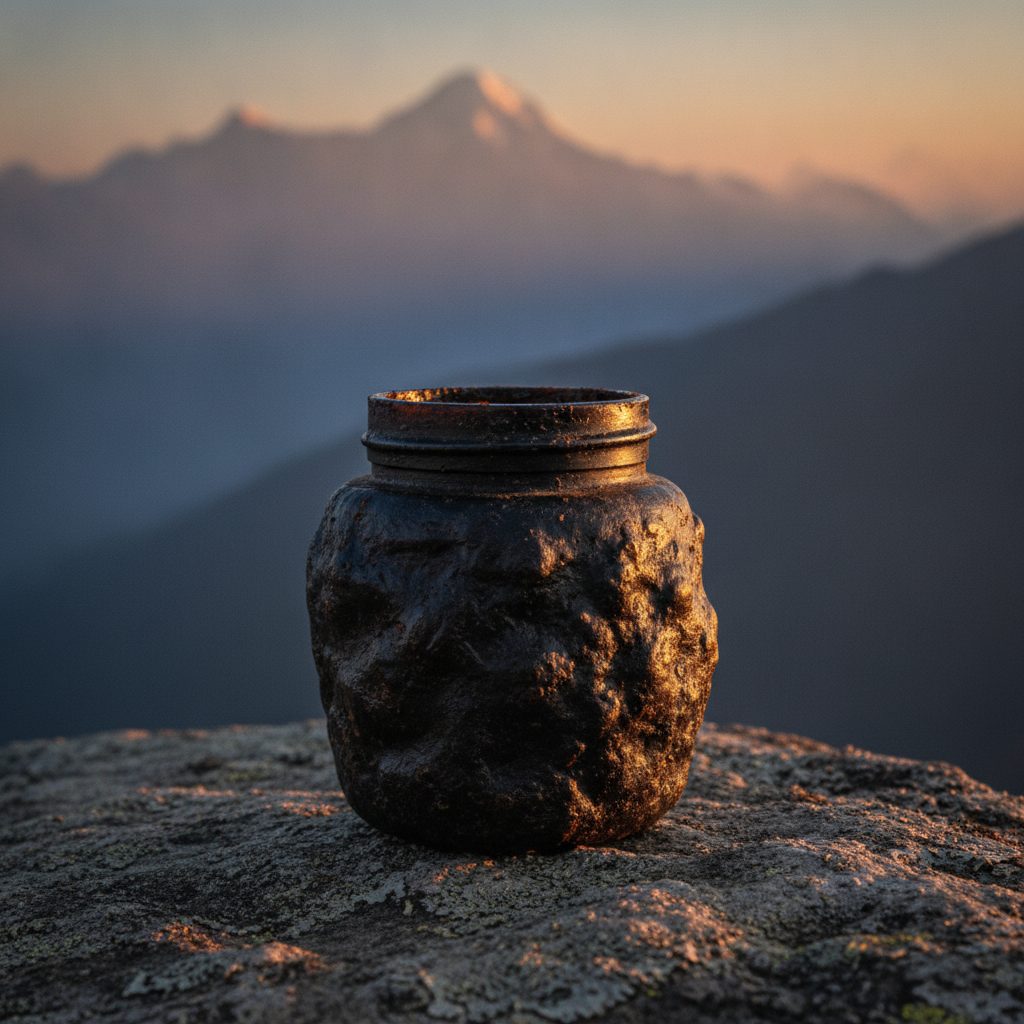
Pure Himalayan shilajit is probably the most common phrase on the market, and it is doing a lot of quiet work. It combines two separate claims, pure and Himalayan, that most buyers read as a single promise of quality. Neither word is regulated, and neither one, on its own, tells you whether the product in front of you is safe or potent. This guide takes the label apart and explains what each half really means, and what actually matters more than both.
Two words, two different claims
The first thing to notice is that pure and Himalayan are not describing the same thing. One is about processing. The other is about geography. A seller can put both on a jar without either being verified.
Pure is a processing claim rather than a sourcing claim, indicating a resin has been purified and cleaned of contaminants, while Himalayan is a sourcing claim describing the region a product was harvested from, and neither term is regulated in the supplement industry. [Kats Botanicals resin guide] Moderate evidence
Pure, at best, should mean the raw material has been filtered and processed so it is safe to consume. That matters, because unprocessed shilajit is not safe to eat. But pure is also one of the least policed words in the supplement aisle. Any brand can print it. Without a certificate, it is a description of intent, not a measured result. Himalayan, meanwhile, only claims a place of origin, and a product labelled that way may in practice have come from the Himalayas, the Altai range, or somewhere unstated entirely.
Raw or native shilajit routinely carries lead, arsenic, cadmium, and mercury, and a 2012 review concluded it should not be consumed unpurified because of the risk from heavy metal ions, mycotoxins, and free radicals, so genuine purification is a real and necessary step. [Carrasco-Gallardo 2012] Strong evidence
Shilajit is not only Himalayan
The marketing has trained buyers to treat Himalayan as a synonym for real, but the substance forms in many high mountain ranges. The same material, or a close chemical relative, appears across a wide stretch of Asia and beyond, under a handful of regional names.
Shilajit occurs across many ranges including the Himalaya, Karakoram, Gilgit-Baltistan in Pakistan, the Altai, the Caucasus, and the Pamir, as well as Afghanistan, Iran, Kyrgyzstan, Mongolia, Nepal, and Russia, with a chemically similar substance found in the Andes of northern Chile. [Wikipedia, sourced to peer-reviewed references] Strong evidence
The same or a related substance is known regionally as mumiyo, mumie, or mumijo in Russia and the Altai, and as brag-shun in Mongolia and Siberia, terms used more or less interchangeably with shilajit in the trade. [Britannica] Strong evidence
This matters for two reasons. First, a product that is genuinely from the Altai is not fake shilajit; it is simply from a different mountain range, and some of the most lab-transparent resin on the market is Altai-sourced. Second, because Himalayan carries a premium, there is an obvious incentive to apply the word whether or not it is accurate. The name on the jar is not a chain of custody.
It also changes how you should read a comparison between two products. If one is labelled Himalayan and the other Altai, that difference alone tells you nothing about which is cleaner or stronger. A tested Altai resin with a published heavy-metal panel is a safer buy than an untested Himalayan one, every time. The range is a label; the testing is the substance. Reading Altai as second best is exactly the assumption the premium pricing on Himalayan is designed to encourage.
Why Himalayan is largely unpoliced
There is no origin authority for shilajit the way there is for, say, Champagne or Darjeeling tea. No inspector verifies the altitude a resin was scraped from, and the finished supplement is not checked for provenance before sale. As a result, the region on the label rests on the seller’s word.
Himalayan functions largely as a marketing term, since much marketed shilajit is Altai or Central Asian or of unspecified origin, and origin labels are frequently unverifiable, so the word alone certifies nothing without a certificate and region or harvest detail. [Actizeet origin explainer] Moderate evidence
A useful heuristic is to distrust vagueness. A seller who names a country, a region, and an extraction method is giving you something to check. A seller who offers only the word Himalayan, with no altitude, no country, and no method, is offering a mood rather than information. The vagueness itself is the signal.
Does origin actually change quality?
Sellers make confident claims that one range yields higher fulvic acid than another, most often that Himalayan resin is richest. It is worth being honest about the status of those claims.
Claims that Himalayan shilajit has higher fulvic acid, sometimes stated as up to about 78 percent by dry weight, while Altai shilajit differs in its humic profile, circulate widely but come from vendors rather than independent standardised testing. [Kashmiril regional comparison 2025] Preliminary evidence
In other words, the range-by-range quality rankings you read are marketing positions, not settled science. Batch-to-batch and processing differences within a single region can easily outweigh any average difference between regions. What a laboratory can measure is the fulvic-acid percentage and the heavy-metal load of the actual jar you are buying, and those numbers do not care which mountain the resin came from. Origin is a story; the certificate is the fact.
Processing is the part that origin marketing tends to skip over, and it is arguably the more important variable. How the raw material is purified determines how much of the heavy-metal load is removed and how much of the active fraction survives. A carefully water-purified resin from an ordinary source can easily be safer and more consistent than a crudely handled one from a celebrated peak. This is why standardised extracts, which are made to a fixed fulvic-acid and DBP specification, sidestep the origin argument altogether: they are defined by what they contain, not where they were found.
What the brands claim versus what a lab certificate proves
Origin marketing follows a predictable script. Setting each claim against the evidence that would confirm it makes the gap obvious.
| Origin claim on the label | What would actually confirm it |
|---|---|
| Pure Himalayan | A batch COA with a heavy-metal panel; the words pure and Himalayan are not measured on any certificate |
| Harvested at 16,000 feet | Named region and harvest method; altitude figures on a label are not independently checked |
| Highest fulvic acid because it is Himalayan | A stated fulvic-acid percentage for the batch, by a named method |
| Authentic gold grade | An authenticity result such as FTIR that rules out humic or synthetic look-alikes |
| Ancient traditional source | Nothing about safety; purification and testing are what make it safe to consume |
A meaningful shilajit certificate shows a batch or lot number matching the jar, ICP-MS heavy-metal results for lead, arsenic, cadmium, and mercury with detection limits, a fulvic-acid percentage by a named method, a test date, and an ISO 17025 accredited lab. [BSCG safety and testing guide] Strong evidence
What real users report
In supplement and nootropic communities, the enthusiasm for the word Himalayan has cooled into something more practical. The recurring view is that origin is interesting but secondary, and that the reliable buyers ask for a certificate rather than a birthplace. Experienced posters point out that some of the most trusted resin is Altai-sourced, and that a vague Himalayan claim with no lab report is a weaker signal than a specific origin backed by testing. As always, this is aggregate sentiment rather than lab evidence, but it lines up with what the science supports: geography is a marketing lever, and the paperwork is what protects the buyer.
How to buy on evidence, not geography
None of this means origin is worthless. A specific, named source is a small point in a product’s favour. It just means origin belongs near the bottom of the checklist, not the top.
- Ask for a batch COA before you weigh any origin claim at all.
- Confirm the heavy-metal panel and a stated fulvic-acid percentage on that certificate.
- Prefer a named country, region, and extraction method over the bare word Himalayan.
- Treat Altai and other named ranges as legitimate, not as second best.
- Read pure as an intention that only a certificate can verify.
Read the label honestly and pure Himalayan shilajit turns from a guarantee into two unregulated words that a certificate either backs up or does not. To go further, learn how to read that document in our guide to the shilajit certificate of analysis, see the full set of quality signals in our buying guide, and browse how real products compare in our brand reviews.
References
- Kats Botanicals. Himalayan versus pure shilajit resin. source
- Carrasco-Gallardo et al. Shilajit, a natural phytocomplex. Int J Alzheimers Dis. 2012. source
- Wikipedia. Shilajit, origins and terminology. source
- Britannica. Shilajit. source
- Actizeet. Is all shilajit from the Himalayas. source
- Kashmiril. Himalayan versus Altai versus Siberian shilajit. 2025. source
- BSCG. Shilajit supplement safety, testing, and compliance guide. source
Leave a Reply