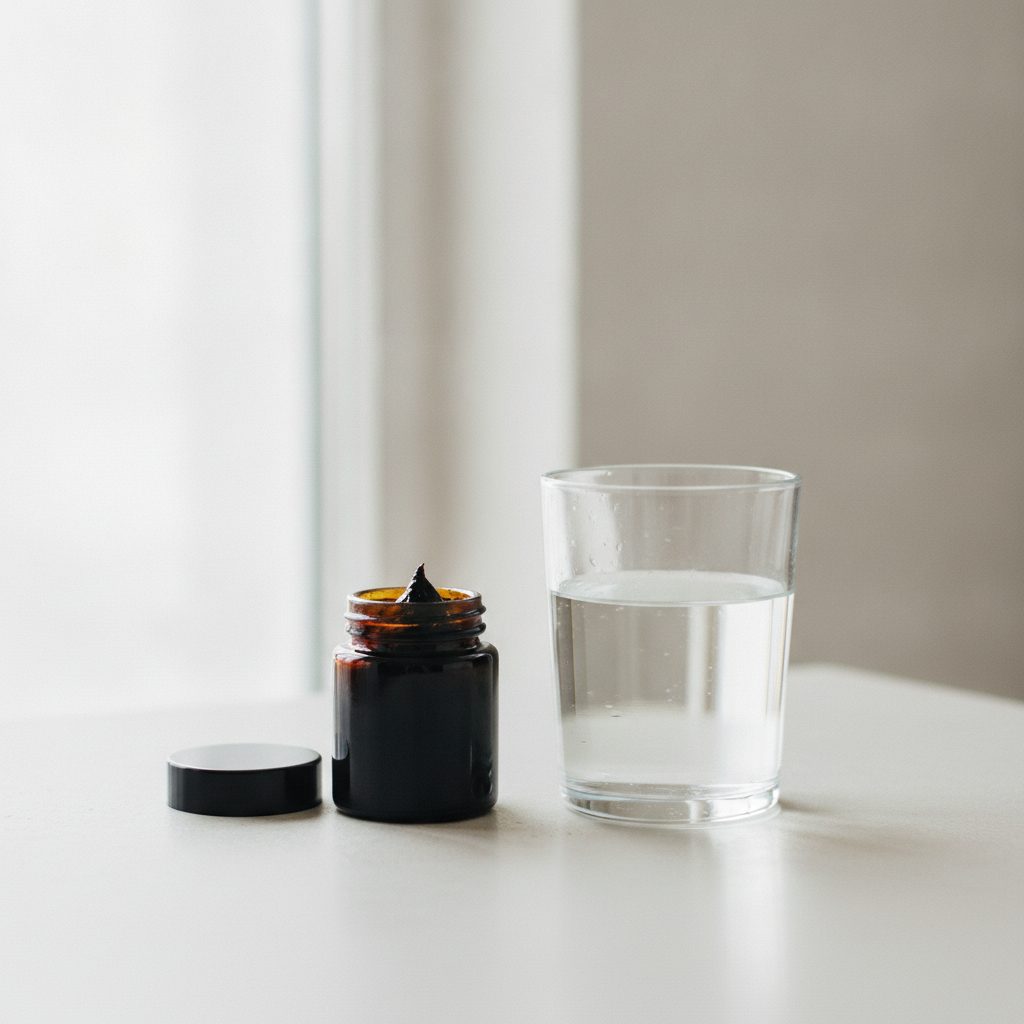
Shilajit is often sold as a kidney tonic, with pages promising it protects, detoxifies and strengthens the kidneys. It is a claim worth taking seriously, because the kidneys filter everything you swallow, so anything you put in your body has to pass through them. When you read the actual research, the kidney story turns out to be almost entirely about rats, while the better-documented kidney issue with shilajit runs in the opposite direction. This page lays out what the evidence supports, what it does not, and who should be cautious.
Educational content, not medical advice. Talk to a qualified clinician before taking shilajit, especially if you are pregnant or breastfeeding, take medication, or have a health condition.
Where the kidney tonic idea comes from
In traditional Ayurvedic and Central Asian use, shilajit was given as a general rejuvenator, and modern sellers have translated that into specific organ claims, including kidney support. The mechanistic story usually offered is that shilajit’s fulvic acid is an antioxidant, that it has mild diuretic properties, and that antioxidants can reduce the oxidative stress involved in some kidney damage. That is a reasonable hypothesis to test. Whether it holds up in living people is a separate question, and the honest answer is that it has barely been tested in people at all.
It is also worth knowing that fulvic acid, the small water-soluble fraction, is described as being absorbed in the gut and cleared within hours, which means the kidneys are directly involved in handling it. That cuts both ways. It is the basis for the antioxidant hypothesis, and it is also why anything toxic riding along with the shilajit ends up passing through the same filtering organ.
Fulvic acid is a low-molecular-weight, water-soluble humic substance that is absorbed in the intestine and cleared within hours, so the kidneys are involved in handling it. [Carrasco-Gallardo 2012, Int J Alzheimers Dis] Preliminary evidence
What the animal studies actually show
The nephroprotective evidence is real, but it is in rats, and it is a specific kind of experiment. Researchers deliberately injure the kidneys of rats using toxic drugs, then test whether shilajit given alongside reduces the damage. In a 2025 study, rats were given the chemotherapy drug 5-fluorouracil to induce kidney injury, and the group that also received shilajit showed reduced oxidative stress, better antioxidant status, creatinine held nearer normal, less cell death, and less visible tissue damage under the microscope.
In rats with 5-fluorouracil-induced kidney injury, shilajit co-administration reduced oxidative stress, preserved antioxidant levels, kept creatinine nearer normal and lessened kidney tissue damage. [Ezer 2025, Iran J Basic Med Sci] Preliminary evidence
Similar rodent experiments have used other kidney toxins and reported the same general pattern, with shilajit lowering markers such as creatinine and blood urea nitrogen and reducing oxidative damage. Taken together, these studies make a consistent case that shilajit can blunt certain kinds of chemically induced kidney injury in animals, most likely through its antioxidant activity.
Two cautions matter, though. First, protecting a rat kidney from a specific poison does not mean improving kidney function in a healthy person, or in someone with chronic kidney disease. Those are different situations. Second, animal results in supplement research frequently fail to reproduce in human trials. This is promising preclinical work, not a demonstrated human benefit.
Why there is no real human kidney evidence
There is no published human clinical trial showing that shilajit improves kidney function or slows kidney disease. The overall shilajit evidence base is small and dominated by animal studies, and the government position reflects that. The US Department of Defense supplement-safety service states there is little reliable evidence for shilajit’s popular claims and that most research has been done in animals. There is no NIH or regulatory endorsement of shilajit for kidney health of any kind.
The US Department of Defense Operation Supplement Safety states there is little reliable evidence to support shilajit's popular claims, with most research conducted in animals, and no government body endorses shilajit for any use. [OPSS, US DoD] Insufficient evidence
A widely cited safety and efficacy review reached a matching conclusion, noting how few well-controlled human studies exist for shilajit overall and calling for more standardised human research. When there is no human kidney trial at all, the correct grade for kidney benefit in people is insufficient, whatever the rat data suggest.
A safety and efficacy review found relatively few well-controlled human studies of shilajit exist and called for more standardised human research before firm conclusions. [Stohs 2014, Phytother Res] Moderate evidence
The kidney risk that is actually documented
Here is the part the tonic marketing tends to skip. The best-substantiated link between shilajit and the kidneys is a risk, not a benefit, and it comes from contamination. The kidneys are a primary target of heavy-metal toxicity, and raw or unpurified shilajit can concentrate lead, arsenic, mercury and cadmium because it accumulates whatever is in its host rock. Feeding your kidneys a contaminated mineral resin is the opposite of protecting them.
Raw or unpurified shilajit can concentrate toxic heavy metals such as lead, arsenic, mercury and cadmium, which are known to target the kidneys. [Stohs 2014, Phytother Res] Moderate evidence
This is not theoretical. Population testing of Ayurvedic products, the category shilajit belongs to, found detectable lead, mercury or arsenic in roughly one in five products sold online, with contaminated products capable of exceeding regulatory intake limits when taken as directed. And a 2025 analysis found thallium, another kidney-toxic metal, in both raw shilajit and finished supplements, with some supplements containing more than the crude material. A purified label is not a guarantee.
Testing of Ayurvedic products found roughly one in five contained detectable lead, mercury or arsenic, with contaminated products capable of exceeding regulatory intake limits when taken as directed. [Saper 2008, JAMA] Strong evidence
Thallium, a kidney-toxic metal, was measured in both raw shilajit and commercial supplements, with some supplements containing more than the raw material. [Kamgar 2025, BMC Chemistry] Moderate evidence
There is also an electrolyte angle relevant to anyone with kidney or blood-pressure concerns. A published case describes a pregnant woman who developed a licorice-like syndrome, with high blood pressure, low potassium and disturbed mineral regulation, after months of daily shilajit use. It is a single case, but it shows shilajit can affect the exact fluid and electrolyte balance that healthy kidneys work to maintain.
A published case report describes a pregnant woman who developed pseudohyperaldosteronism, with hypertension and low potassium, after around six months of daily shilajit use. [Stavropoulos 2018, Gynecol Endocrinol] Preliminary evidence
Kidney stones and uric acid: unresolved
Two related questions come up constantly, and the honest answer to both is that the evidence is mixed and thin. On kidney stones, sellers point to shilajit’s mild diuretic action as a reason it might help flush stone-forming minerals, while others note that shilajit contains oxalates, which can contribute to the most common type of stone. Neither claim rests on human stone-outcome trials, so the net effect is genuinely uncertain.
On uric acid, some sources report that shilajit increases urinary uric acid excretion, which for most people would be neutral or even helpful, while others worry it could raise uric acid burden. The direction is not settled. For anyone with gout, a history of uric acid stones, or existing kidney disease, that uncertainty is itself a reason to be cautious and to involve a clinician rather than self-experimenting.
What the brands claim vs what the evidence shows
- Brands say shilajit is a kidney tonic that protects and strengthens the kidneys. Evidence shows rat studies of drug-induced injury and no human kidney trial, so kidney benefit in people is unproven.
- Brands say its diuretic action helps prevent kidney stones. Evidence shows no human stone-outcome data, and shilajit also contains oxalates, leaving the effect uncertain.
- Brands say it helps regulate uric acid and supports creatinine and urea. Evidence shows mixed reports on uric acid and rodent-only data on kidney markers.
- Better brands say the real kidney concern is contamination in raw resin. Evidence shows this is correct and is the strongest kidney-related finding of all.
The more responsible sellers frame shilajit defensively, saying that for a healthy adult a pure, properly processed product is not considered bad for the kidneys, and stressing hydration and third-party testing. That is closer to the evidence than the tonic language, though it is still a claim about safety rather than benefit.
What real users report
In forums, kidney questions split into two camps. People with healthy kidneys mostly ask whether shilajit could harm them and whether their product is clean, and the experienced community answer is consistently to buy purified, lab-tested resin, stay well hydrated, and avoid loose unbranded material. People with existing kidney conditions, or a history of stones or gout, more often ask whether it is safe at all, and the common and sensible reply is to clear it with their doctor first rather than rely on tonic marketing.
What you rarely see is anyone reporting a measurable kidney improvement they could actually verify. The discussion is dominated by safety and product-quality worries, which lines up well with where the real evidence sits.
The honest bottom line
Is shilajit good for your kidneys? For a healthy person, the fair answer is that there is no human evidence it helps, some promising but preliminary animal evidence that it can reduce certain drug-induced kidney injuries, and a well-documented risk that contaminated product can harm the kidneys rather than protect them. If you have kidney disease, a history of kidney stones, gout, or you are pregnant, the balance tilts firmly toward caution, and this is a decision to make with a clinician rather than a supplement label.
If you do use shilajit, the single most protective step for your kidneys is to choose a purified product with a recent certificate of analysis that tests for arsenic, lead, mercury and cadmium, and ideally thallium, and to stay well hydrated. For the contamination detail see our coverage of shilajit side effects, for the underlying research read the science overview, and to buy a tested product read the buying guide.
Educational content, not medical advice. Talk to a qualified clinician before taking shilajit, especially if you are pregnant or breastfeeding, take medication, or have a health condition.
References
- Ezer M, et al. Investigation of the molecular and cellular effects of shilajit on 5-fluorouracil-induced nephrotoxicity in rats. Iran J Basic Med Sci. 2025;28(5):565-574. PMID 40666183
- Carrasco-Gallardo C, Guzman L, Maccioni RB. Shilajit: a natural phytocomplex with potential procognitive activity. Int J Alzheimers Dis. 2012;2012:674142. PMID 22482077
- Stohs SJ. Safety and efficacy of shilajit. Phytother Res. 2014;28(4):475-9. PMID 23733436
- Saper RB, et al. Lead, mercury, and arsenic in US- and Indian-manufactured Ayurvedic medicines sold via the internet. JAMA. 2008;300(8):915-23. PMID 18728265
- Kamgar E, et al. Quantifying of thallium in shilajit and its supplements. BMC Chemistry. 2025. PMID 39827344
- Stavropoulos K, et al. Pseudohyperaldosteronism due to mumijo consumption during pregnancy: a licorice-like syndrome. Gynecol Endocrinol. 2018;34(12):1019-1021. PMID 29933704
- Operation Supplement Safety (US DoD). Shilajit as a dietary supplement ingredient. opss.org
Leave a Reply