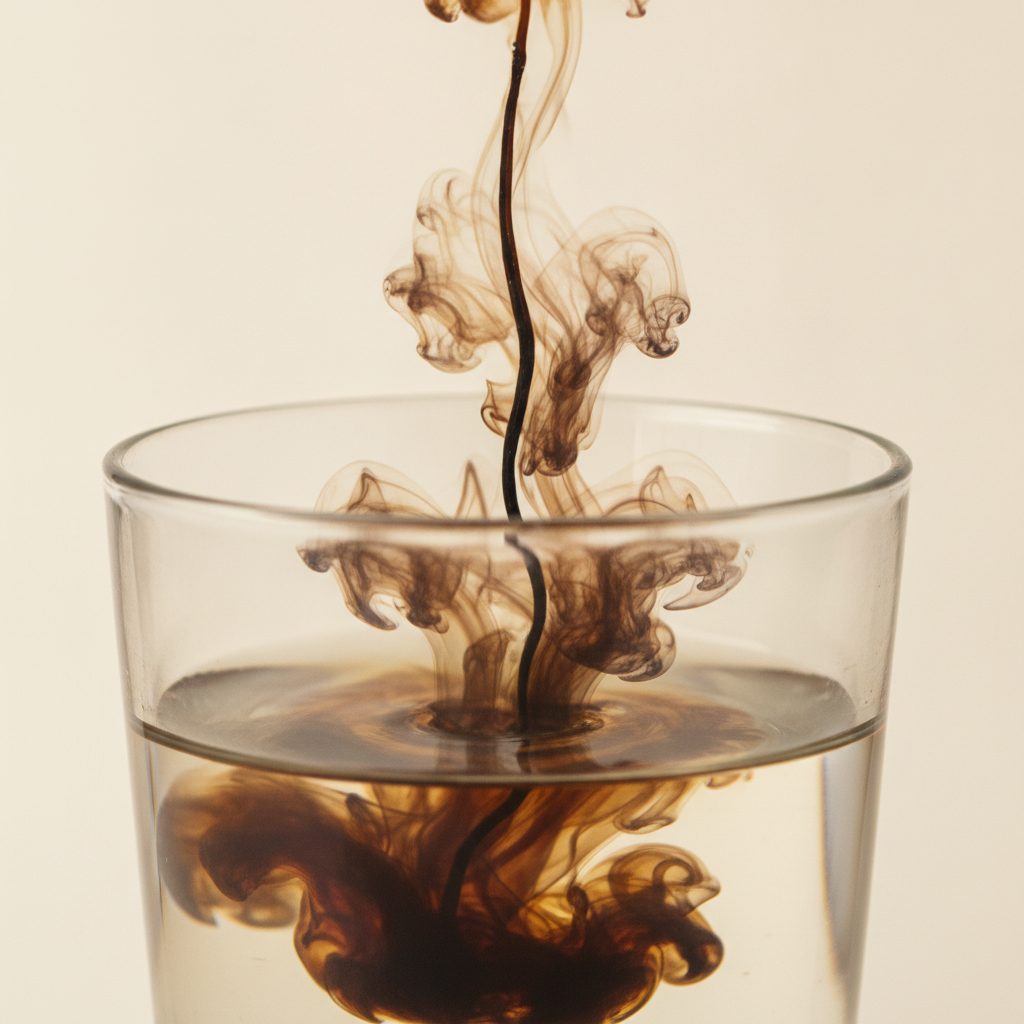
Resin is the form shilajit purists prefer, and the one that trips up the most first-timers. It is sticky, bitter, and dosed by eye, which makes it both the most concentrated option and the least precise. This guide covers how to dissolve it, how to think about the dose honestly, and which of the widely repeated warnings are real cautions versus sales hooks dressed up as chemistry.
Educational content, not medical advice. Talk to a qualified clinician before taking shilajit, especially if you are pregnant or breastfeeding, take medication, or have a health condition.
How to dissolve resin, step by step
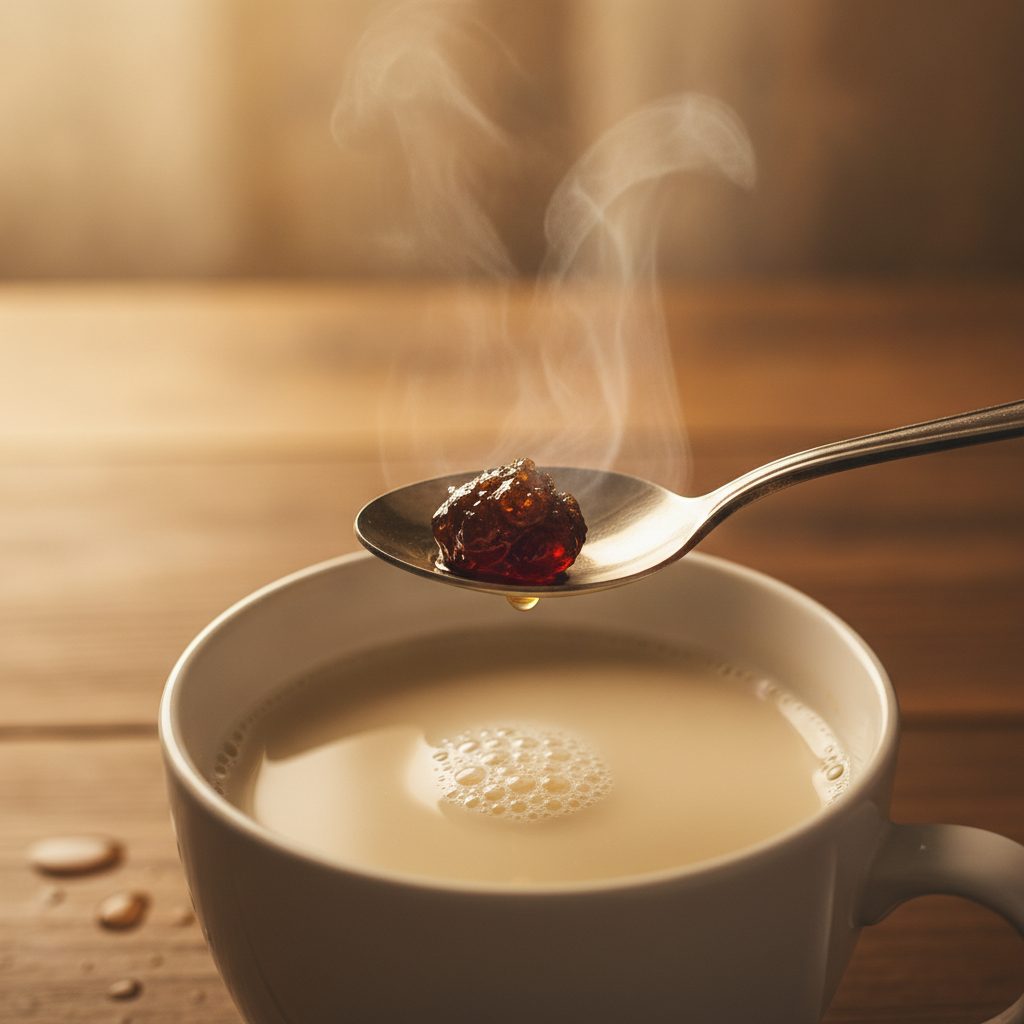
The standard method is to stir a dose of resin into about 4 to 6 ounces of warm, not boiling, liquid: water, milk, or a herbal tea. Authentic resin dissolves in roughly 5 to 10 minutes into a golden-brown or amber liquid. Grit or lumps that refuse to dissolve are the red flag users cite most often for a fake or adulterated product.
A dose of resin is typically dissolved in 4 to 6 ounces of warm, not boiling, water, milk or tea, dissolving in 5 to 10 minutes into an amber liquid. [Everest how-to] Preliminary evidence
The warm-not-boiling advice rests on the reasonable premise that some of the constituents are heat-sensitive. It is worth noting that the exact degradation temperature has not been precisely characterised in peer-reviewed literature, so this is a sensible precaution rather than a measured threshold. Warm tap-temperature water is a safe default.
Dosing resin honestly
Typical self-dosing for resin is described as a rice-grain to pea-sized amount, roughly 300 to 500 mg, once a day, with most guidance suggesting not exceeding around 500 mg per day. That is the traditional and vendor practice, but no trial validated visual dosing, and eyeballing a sticky blob is the core accuracy weakness of resin.
Typical raw-resin self-dosing is a rice-grain to pea-sized amount, roughly 300 to 500 mg once daily, though no trial validated this visual method. [Healthyroots how-to] Preliminary evidence
There is a bigger dosing subtlety that most resin guides skip. The human trials used purified, standardised extract with a defined fulvic-acid content, so their 250 to 500 mg figures refer to standardised extract, not raw resin. Because fulvic-acid content varies enormously between products, a pea-sized resin dose and a 500 mg standardised capsule can deliver very different amounts of active compounds. Buy to the fulvic-acid spec on the certificate of analysis, not to gross weight.
Trial milligram figures refer to standardized extract, and fulvic-acid content varies enormously across products, so equal weights of resin and standardized extract are not equivalent. [Carrasco-Gallardo 2012] Strong evidence
Common mistakes and myths
Three cautions get repeated as hard rules across resin how-to pages. All three are worth a closer look, because the honest version is more useful than the scary version.
The chlorinated tap water warning
Many pages insist you must never dissolve shilajit in chlorinated tap water because chlorine reacts with fulvic and humic acids to form toxic byproducts. The underlying chemistry is real in the abstract: humic and fulvic acids are known precursors of disinfection byproducts in water-treatment science. But the quantity formed from a single 300 to 500 mg dose stirred into a glass is negligible, and the warning is overwhelmingly used as a hook to sell branded or spring water. Honest framing: use filtered or spring water if you prefer, but no toxicology study of shilajit in tap water backs the toxic framing.
The claim that chlorinated tap water makes shilajit toxic is overstated; humic and fulvic acids are disinfection-byproduct precursors in water treatment, but the amount from a single dose is negligible and no shilajit-specific toxicology supports the warning. [Fulvic acid assessment, PMC7758121] Insufficient evidence
The metal spoon warning
The advice not to stir with a reactive metal spoon, such as aluminium, copper or unlined iron, is plausible in theory: mild acidity and chelation could in principle leach a trace of metal ions. In practice, brief contact during stirring is trivial, and this is largely folklore rather than a demonstrated hazard. If you would rather not think about it, a wood, plastic or glass stirrer is a harmless default. It should not be presented as a proven danger.
The mandatory cycling myth
You will also see that resin must be cycled, six to eight weeks on and a week or two off, to prevent tolerance. There is no clinical evidence of tolerance or receptor desensitisation to shilajit, and the trials that reported benefits dosed continuously for 90 days with no washout. Cycling is a cautious optional habit, not a requirement.
There is no clinical evidence of tolerance to shilajit, and the positive trials dosed continuously for 90 days with no washout, so cycling is optional rather than required. [Pandit 2016] Moderate evidence
A sensible first-timer routine
- Buy purified, third-party lab-tested resin only. This is the one point every authority agrees on.
- Start low, around a rice-grain size, for the first week or two to check tolerance; mild digestive upset was reported in fewer than 5 percent of trial subjects.
- Dissolve in 4 to 6 ounces of warm, not boiling, water or milk and stir for 5 to 10 minutes.
- If you take an iron supplement, space it a couple of hours apart as a low-risk precaution.
- Judge results in months, not days. The measured trial effects appeared at 60 to 90 days.
Resin rewards patience and punishes guesswork. If precise dosing matters to you, compare it against the other forms in our forms comparison, check purity standards in the buying guide, and see how the doses were tested in the science overview.
Educational content, not medical advice. Talk to a qualified clinician before taking shilajit, especially if you are pregnant or breastfeeding, take medication, or have a health condition.
References
- Pandit S, et al. Clinical evaluation of purified shilajit on testosterone levels in healthy volunteers. Andrologia. 2016;48(5):570-5. PMID 26395129
- Carrasco-Gallardo C, et al. Shilajit: a natural phytocomplex with potential procognitive activity. Int J Alzheimers Dis. 2012;2012:674142. PMC3296184
- Toxicological assessment of fulvic acid. Food Chem Toxicol. PMC7758121
Leave a Reply