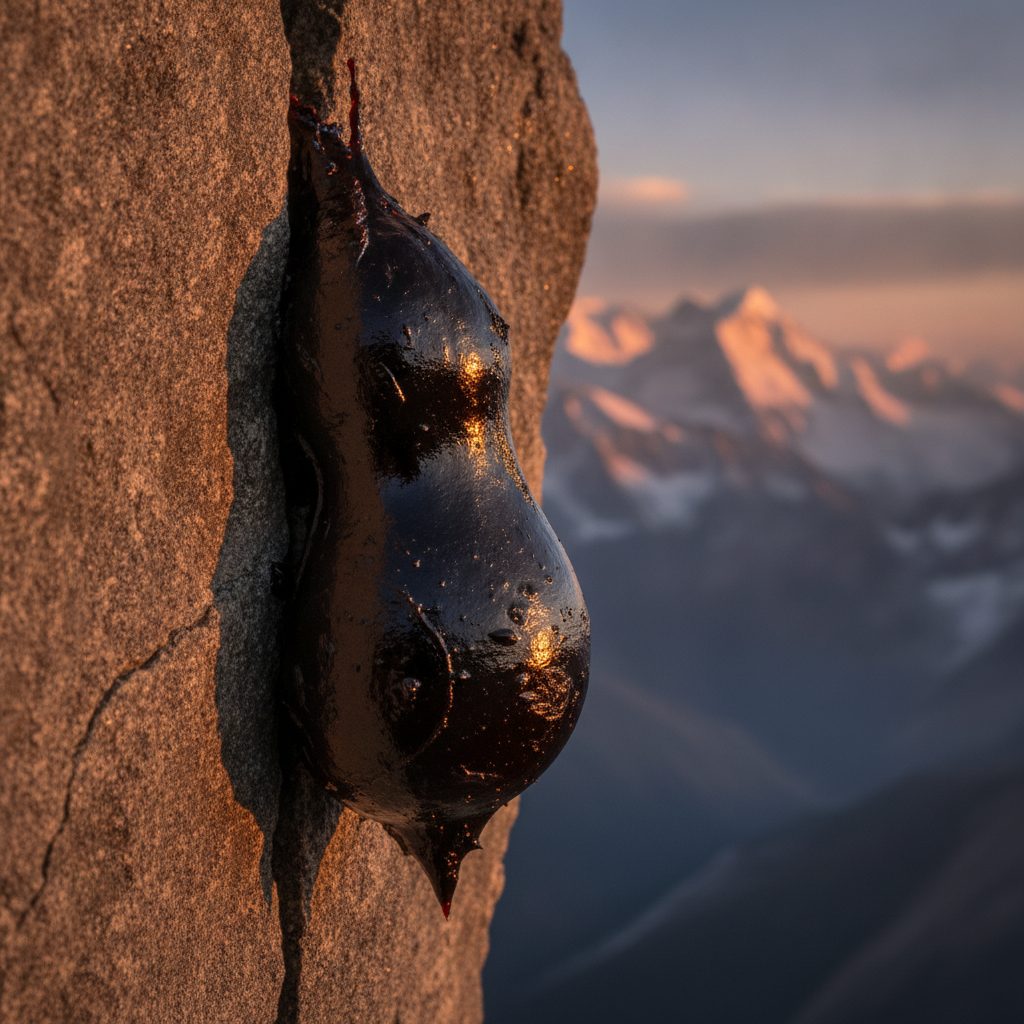
Himalayan shilajit is sold as the premium original, with Altai and Siberian versions framed as lesser alternatives. The reality is more mundane. Shilajit forms across many mountain ranges, the origin printed on a jar is often unverifiable, and word Himalayan does far less work than most marketing suggests. Here is what the source actually tells you, and what it does not.
Where shilajit actually comes from
Shilajit occurs across many mountain ranges, including the Himalaya, Karakoram, Gilgit-Baltistan in Pakistan, the Altai, the Caucasus, the Pamir in Tajikistan, plus Afghanistan, Iran, Kyrgyzstan, Mongolia, Nepal, and Russia, with a chemically similar Andean version found in northern Chile. [Wikipedia, peer-referenced] Strong evidence
The same or a closely related substance carries different regional names, including mumiyo or mumijo in Russia and the Altai, and brag-shun, meaning oil of the mountains, in Mongolia and Siberia, and these terms are used interchangeably in the trade. [Britannica] Strong evidence
In other words, Himalayan and Altai are not two separate substances so much as the same class of mineral exudate from different mountains. That single fact undercuts most of the origin-based marketing in the category.
What Himalayan really means on a label
Himalayan functions largely as a marketing term, because much marketed shilajit is Altai or Central Asian or unspecified, and origin labels are frequently unverifiable. [Actizeet origin explainer] Moderate evidence
The word Himalayan on a jar certifies nothing by itself. There is no policing of the term, no required documentation behind it, and no way for a buyer to confirm it from the label alone. That does not mean origin is worthless information. It means origin only counts when it is specific and paired with proof.
Vague sourcing, such as the word Himalayan with no country, region, altitude, or harvest method, is a red flag, whereas reputable sellers name the region and extraction method. [Actizeet origin explainer] Moderate evidence
The claimed differences between regions
Sellers often claim Himalayan shilajit is richer in fulvic acid while Altai material is lower-altitude with heavier humic substances. These figures circulate widely, but they come from vendors rather than independent standards.
Claimed regional differences, such as Himalayan shilajit reportedly reaching up to around 78 percent fulvic acid and Altai being lower-altitude with higher-molecular-weight humic substances, are vendor claims rather than independently standardised findings. [Kashmiril brand comparison 2025] Preliminary evidence
Treat those numbers as marketing until an independent certificate backs them. The high fulvic percentages quoted for Himalayan material tend to originate with the people selling it, not from peer-reviewed comparison of regions.
Does the source affect safety?
This is where origin does carry some real weight, though not in the way the marketing implies. Raw shilajit concentrates whatever is in its host rock, so contaminant levels can differ from one deposit to another. That variation is a reason to test, not a reason to trust a region name.
In a 2025 analysis, thallium in raw shilajit ranged from below the detection limit to about 0.226 micrograms per gram, with the highest reading in a sample from Saravan in Iran, showing that contamination can vary by source. [Kamgar 2025, BMC Chemistry] Strong evidence
Because contamination varies by deposit and cannot be read off a label, the certificate of analysis remains the deciding document regardless of which range the product claims to come from.
A meaningful shilajit COA, with batch-matched heavy-metal results from an accredited lab and a stated fulvic-acid percentage, is what confirms safety and potency, which origin labelling alone cannot do. [BSCG safety and testing guide] Strong evidence
Myths versus reality
| The marketing | The reality |
|---|---|
| Himalayan is the only real shilajit | Shilajit forms in many ranges, from the Altai to the Caucasus to the Andes. |
| Himalayan on the label proves premium quality | The term is unpoliced and often unverifiable, so it proves nothing alone. |
| Himalayan always has more fulvic acid | The high percentages are vendor claims, not independent findings. |
| A trusted region means it is safe | Contamination varies by deposit; only a certificate confirms safety. |
What to check instead of the region
- A specific, named region and harvest or extraction method, not just the word Himalayan.
- A batch-matched certificate of analysis with a heavy-metal panel from an accredited lab.
- A stated fulvic-acid percentage by a named method, rather than a vendor headline figure.
- A realistic price, since a suspiciously cheap origin story is usually just a story.
Origin is a supporting detail, useful when it is specific and honest, meaningless when it is a single vague word. The certificate is what settles the question. For the next step, see how brands handle sourcing and testing in our brand reviews, read the wider evidence on shilajit, or check the common questions in our FAQ.
References
- Wikipedia. Shilajit, origins and terminology. source
- Britannica. Shilajit. source
- Actizeet. Is all shilajit from the Himalayas. source
- Kashmiril. Himalayan versus Altai versus Siberian shilajit. 2025. source
- Kamgar et al. Quantifying thallium in shilajit and its supplements. BMC Chemistry. 2025. source
- BSCG. Shilajit supplement safety, testing, and compliance guide. source
Leave a Reply